
Loading...


Presto Laboratories can provide extensive testing of industrial safety helmets based on the specification of industrial safety helmets. The testing program would be able to test the protective performance, structural integrity, and durability of the helmets under mechanical, environmental, and functional distressing conditions as provided in the Indian Standard.
These are the tests that aid in assuring that the safety helmets provide enough head protection to the users that work in industrial, construction, electrical, and hazardous workplaces, as well as comply with the statutory and customer request requirements.
The safety helmets offered by industries must be used to shield the user against impact, penetration, and other industrial hazards. As time passes, the ability of the helmet to resist exposure to sunlight, temperature fluctuation, moisture, and mechanical strain could impair its ability.
The testing, according to IS 4151, is mandatory to
All tests at Presto Laboratories are done as per the requirements, conditioning requirements, and acceptance criteria stipulated in the IS 4151.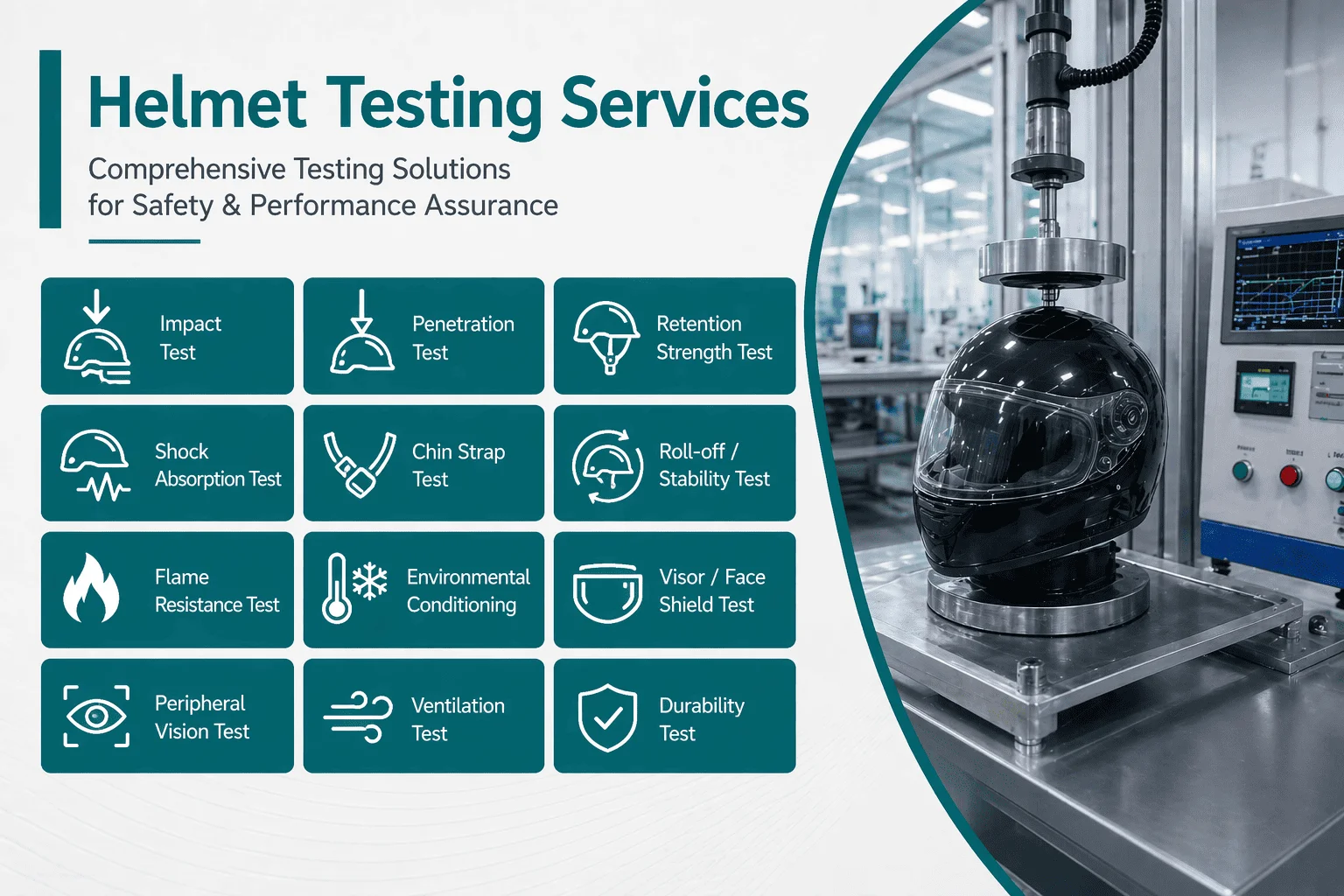
The impact absorption test is a test that measures the effectiveness of the helmet at absorbing the impacting force given to the head.
In this test:
This test assesses the helmet’s resistance to penetration by sharp or pointed objects.
Being able to pass by this test makes it clear that the helmet shell is sufficiently protective against falling or flying objects at work.
The retention system (chin strap) plays a vital role in keeping the helmet in place over the head during use.
This test checks:
The helmet must withstand the specified load without failure or excessive elongation.
To simulate real-world usage conditions, helmets are subjected to environmental conditioning before mechanical testing.
Conditioning includes exposure to:
After the conditioning phase, helmets are again tested on the effectiveness of impact absorption and penetration resistance to ensure there is no impairment in their performance.
This test evaluates the resistance of the helmet shell to lateral deformation under load.
That is to make sure that the helmet remains in its structural integrity and fit while in use.
In addition to performance testing, helmets undergo the following:
All the tests of helmets at Presto Laboratories are conducted on generally recognized test equipment and standardized headforms. All the steps of testing are recorded in writing, and every measurement taken is recorded so that they can be traced.
Our testing process includes:
Clients will have a test report in which they will receive:
Reports are suitable for QAI certification, internal quality assurance, and customer submissions.
Our lab is equipped with world-class testing technology to replicate real-world automotive stresses:
The test of a helmet done at Presto Laboratories is guided by a systematic plan of a set of Indian standards that determine safety, strength, and performance tests on various types of helmets. These standards inform the testing of helmets in terms of impact, penetration, environmental exposure, and long-term use to ensure that the results remain the same for the domestic and industrial applications.
The protective helmets used in IS 4151 are very common and concentrate on the area of impact absorption, penetration resistance, retention system strength, and the entire construction. It defines how helmets should perform during sudden impact and under different environmental conditions.
IS 2925 applies to industrial safety helmets used in construction and factory environments. It checks shock absorption, structural strength, and resistance to external forces faced during daily operations.
IS 2745 is used for nonmetal helmets designed for firemen and civil defense personnel. It includes testing for heat resistance, flame exposure, and impact protection under emergency conditions.
IS 9562 covers helmets designed for police forces. It evaluates durability, strength, and performance under field use where impact and stress are common.
IS 9973 focuses on visor testing. It verifies transparency, scratch resistance, and visibility that is significant in safe visual conditions in riding or industrial applications.
Collectively, these standards create a thorough testing framework that aids in checking the safety of helmets, their wear and tear, and certification or market placements.

 Talk to Us
 Book a Test
 Drop a Query