
Loading...


Presto Laboratories is widely recognized as an advanced material testing and research laboratory with strong expertise in both material evaluation and product performance studies. Its foundation reflects the legacy of FAN Services, where the focus has always remained on precise testing, detailed analysis, and real industry relevance.
The laboratory handles a wide scope of testing areas. This includes plastic testing, rubber testing, metal and alloy testing, composites and FRP testing, refractory testing, and rocks and minerals analysis. It also supports reverse engineering, product development, research work, failure analysis, and corrosion studies.
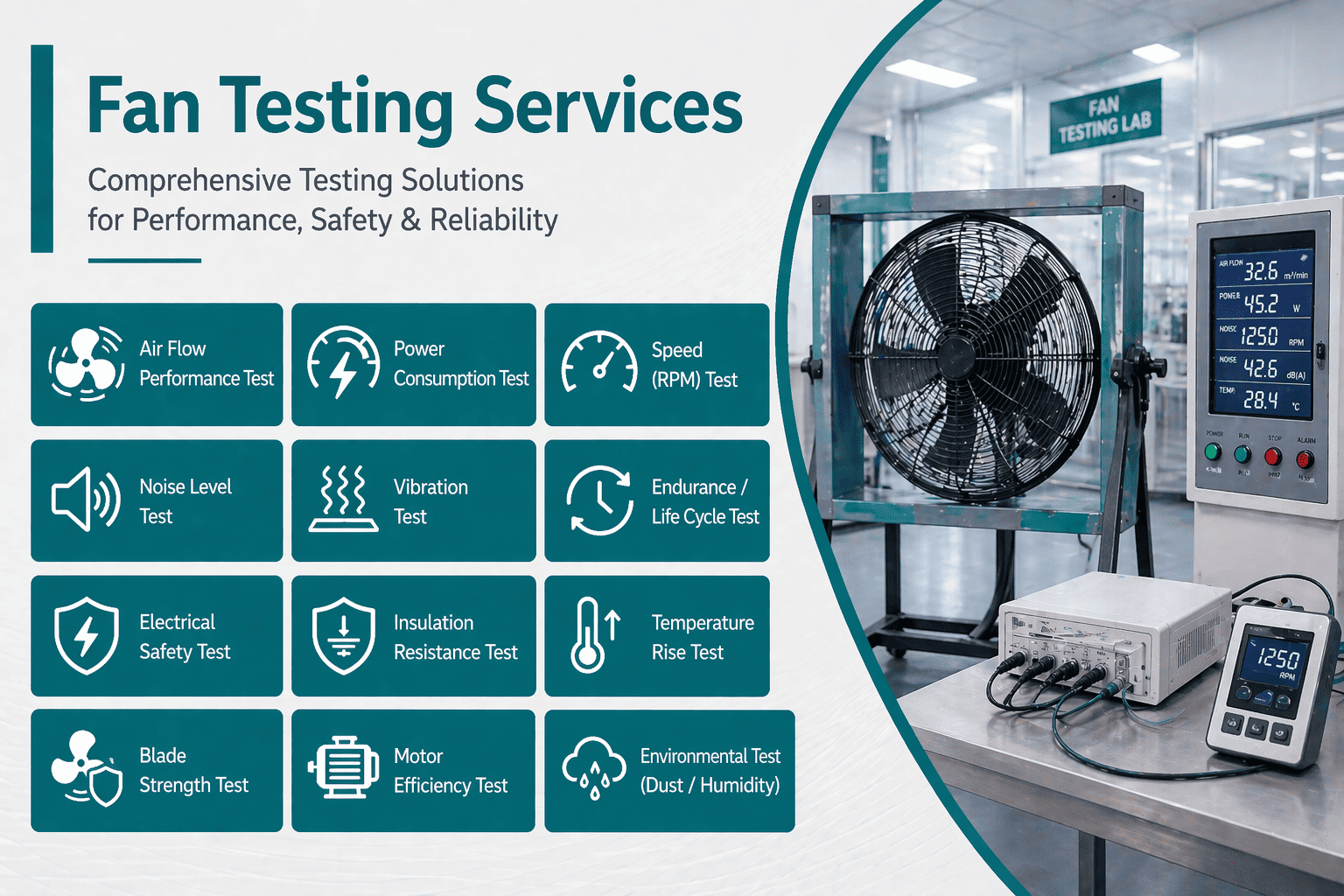
In addition to testing of materials, Presto Laboratories also provides entire testing on electric fans, including ceiling fans, pedestal fans, table fans, wall-mounted fans, and exhaust fans. Testing is all conducted under controlled laboratory conditions where electrical safety, mechanical strength, thermal performance, and performance consistency are closely studied.
The tests demonstrate that fans are capable of long, safe operation; performance is rated in challenging conditions; and constant output is achieved during the service life. With modern infrastructure and experienced technical teams, this Advanced Material Testing and Research Laboratory helps industries understand real product behavior and move forward with clarity and confidence.
| S.No. | IS No. | IS Name |
|---|---|---|
| 1 | IS 374 | Electric Ceiling Type Fans - Specification (Fourth Revision) |
| 2 | IS 555 | Specification for Electric Table Type Fans and Regulators (Third Revision) |
| 3 | IS 1169 | Specification for Electric Pedestal Type Fans and Regulators (First Revision) |
| 4 | IS 2312 | Specification for Propeller Type AC Ventilating Fans (First Revision) |
| 5 | IS 302 (Part 2/Sec 80) | Household and Similar Electrical Appliances – Safety: Part 2-80 Particular Requirements for Fans (First Revision) |
In Presto Laboratories, they are tested according to these defined IS codes so as to ensure all types of fans are treated in the appropriate manner.
This standard is based on electric ceiling fans. It addresses airflow, speed performance, power consumption, and strength of insulation. In the 2019 update, the performance expectations are up-to-date. There is also a test, such as checking the balance of the blade and even checking the smooth rotation through testing, to use it for a long time.
This is with table fans and their regulators. It comprises speed, safety, and functional stability verification checks. Secondary security personnel and air delivery are also examined with the objective of ensuring safe use in close environments.
Pedestal fans are put through stability tests, height adjustment, and oscillation performance tests. This standard also tests the safety and durability of electricity when operating continuously.
Propeller-type AC ventilating fans are subject to this standard. It is concerned with efficiency in terms of airflow, strength of the construction, and continuous running durability. The fans are usually employed in closed places and industries.
This is a safety standard for household and other related electric fans. It tests protection against electric shocks, risk of overheating, and access to live parts. The 2017 edition is in line with the current safety requirements and addresses both typical and faulty states.
With such norms, Presto Laboratories ensures fans maintain consistency in their operation and safety when dealing with actual performance.
Testing a fan helps you avoid unpleasant surprises later. Here’s why it matters:
Electric fans operate for long durations and include rotating parts and electrical components. Weak design or assembly can cause overheating, shock, or injury.
Fan testing is carried out to:
Presto Laboratories performs testing using standardized procedures under controlled conditions to ensure reliable results.
Electrical safety testing confirms insulation and user protection.
These tests ensure electrical safety during normal and fault conditions.
Fans are operated under rated conditions to evaluate heating effects.
This ensures prolonged use does not cause overheating or fire hazards.
Mechanical tests verify durability and construction quality.
These checks ensure rotating parts remain secure and safe.
Stability tests confirm that portable and pedestal fans do not tip during use.
These tests support safe and comfortable user experience.
Non-metallic and insulating materials are evaluated for heat resistance.
This ensures long-term material durability.
All testing is performed using calibrated equipment and documented procedures.

 Talk to Us
 Book a Test
 Drop a Query