
Loading...

A geyser is a daily comfort. You turn on the tap, and you find hot water coming without even considering what happens inside the metal body attached to the wall. A geyser uses all three: heat, pressure, and electricity, all together. A small fault can create a big danger. This is why proper testing is extremely important for the geyser and make sure it meets the safety rules that the Bureau of Indian Standards (BIS) has said are important. Proper testing of a geyser is very important to keep us safe..
In winter, a geyser is like a constant companion for bathing, washing, and other domestic necessities. Due to its importance, it cannot be neglected, as its safety and performance have to be ensured. This is where geyser testing comes in.
A geyser can be thought of as being plain and easy on the outside, but inside, there can be heating coils, pressure adjustments, thermostats, wiring, insulation blankets, and more. All these must work together correctly.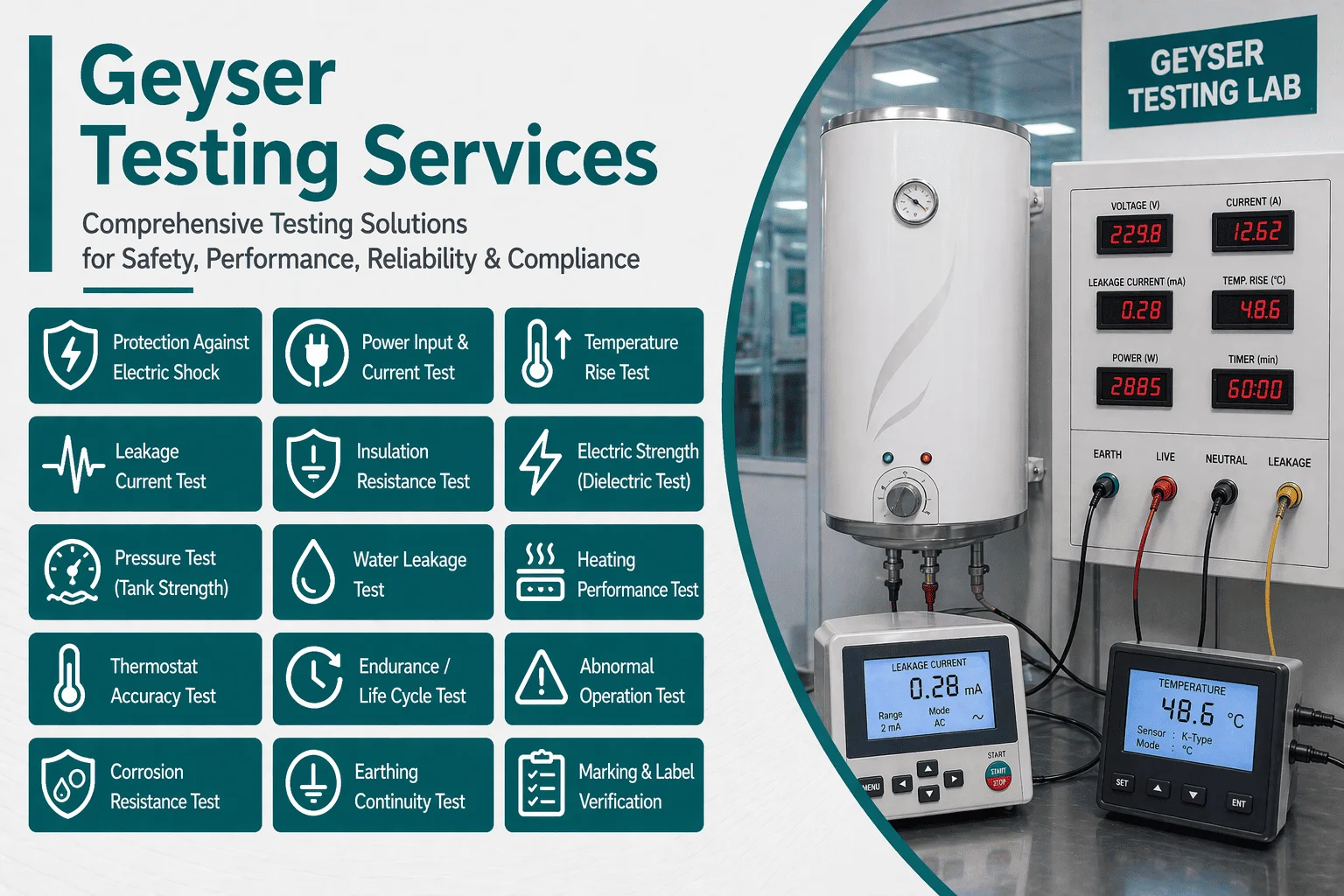
These dangers do not show from the outside; they appear only during detailed internal checks. Therefore, testing becomes the backbone of safety and trust-for household water heaters, that trust is anchored in meeting BIS-notified safety benchmarks before a unit ever reaches a home.
Geyser testing happens in layers. Each test focuses on a specific area to detect problems early, before the appliance reaches customers.
Water should not become hot too quickly or too slowly. At the correct time, the thermostat needs to switch off. Engineers test geysers at fixed water levels to observe their behavior.
When you use water, it raises the pressure inside the geyser. The geyser has to be strong to avoid an explosion. Controlled pressure tests help see if the geyser can handle the pressure from the water safely. We need to make sure the geyser is safe to use with water and that it can hold the pressure
A geyser must be completely sealed. Water is filled into the tank and monitored. Any leak of even a small amount is a failure since it may escalate in the future.
Safety in electricity is very critical. Some of the tests are inspection of the insulation, quality of wiring, earthing, and coil connection of the heating and thermostat.
The inner tank is constantly filled with water. A weak inner coating may lead to rust. Testers check on the evenness, strength, and durability of the coating.
Some geysers produce sudden temperature jumps. Stability tests check whether the geyser maintains steady heat without spikes.
Geysers are subjected to cyclic heating and cooling to learn about long-term performance and longevity.
Many geyser issues start quietly and grow over time. Testing helps detect them early.
After identification, such problems are rectified, or the unit is discarded.
Buyers desire long-lasting and safe geysers in a market that is full of brands. Testing builds trust. It assists the manufacturers in correcting the design flaws prior to products being made available to customers.
In simple words, geyser testing acts as the invisible shield that keeps homes safe.
Geyser tests in Presto Laboratories are conducted under well-established Indian and international standards that direct the manner in which safety, performance, and durability tests are conducted. These standards establish specific guidelines regarding testing conditions, limits, and acceptance levels so that testing results will be consistent and have international market acceptance.
Among the standards, the important one is the IS 2082, which is concerned with the storage-type electric water heaters. It sets standards of heating performance, quality of the construction, pressure performance, and safety. This norm assists in verifying that a geyser is safe to function during the moderate usage by households.
IS 302 Part 1 is concerned with general requirements for the safety of electric appliances. It also has insulation, earthing, leakage current checks, and electric shock protection checks. This provides the foundation for protection to geysers.
IS 302 Part 2 Section 21 specifically deals with water heaters. It includes a fine-tuning of temperature regulation, malfunctioning, and anti-overheating. This aids in validating that even under fault circumstances, the geysers are safe.
CEC standards IEC 60335-1 and IEC 60335-2-21 are commonly used internationally. Such standards include electrical safety and specific requirements of storage water heaters. These are thermal safety, moisture resistance, and mechanical strength tests.
Using these standards, Presto Laboratories ensures geysers comply with safety expectations, helps in getting certification requirements, and assists manufacturers in providing products that perform satisfactorily when subjected to time conditions.
Presto Laboratories conducts geyser testing with precision and care. The team checks heating speed, pressure handling, leakage resistance, inner coating strength, and electrical safety.
All tests follow national guidelines. The goal is simple—a geyser should warm your life, not worry you. Presto's testing ensures this.

 Talk to Us
 Book a Test
 Drop a Query