
Loading...


(As per IS 302 Series)
Presto Laboratories provides comprehensive safety testing services for household and similar electrical appliances in accordance with the IS 302 series of standards, which are aligned with IEC 60335. The testing program is designed to evaluate electrical, mechanical, thermal, and fire safety aspects of appliances intended for domestic and similar use.
These tests ensure that electrical appliances are safe for users during normal operation as well as under foreseeable misuse conditions, and that they comply with statutory requirements for manufacturing, certification, and market placement in India.
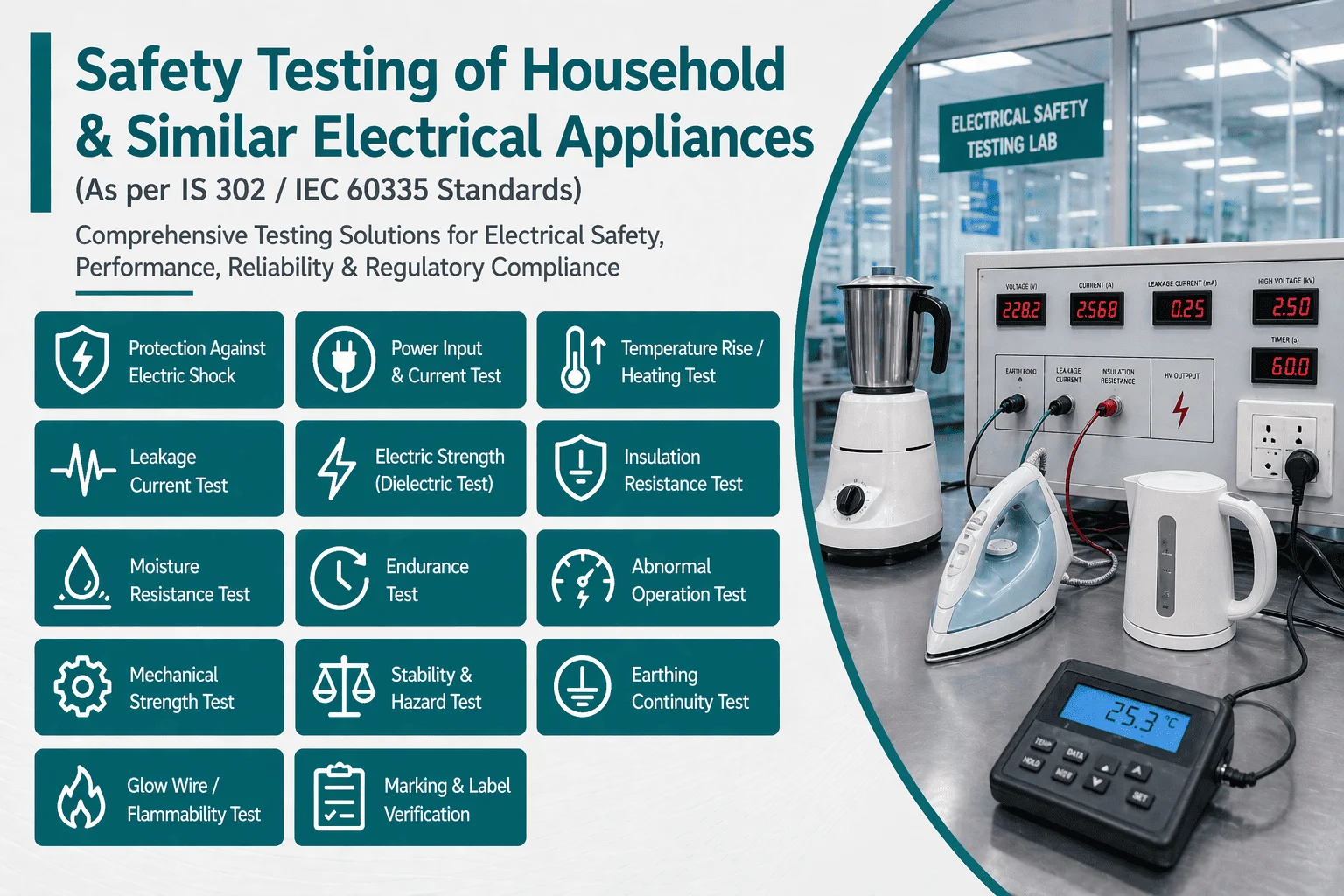
Household electrical appliances operate continuously in close proximity to users and are exposed to variations in voltage, temperature, moisture, and mechanical handling. Any design or manufacturing defect can result in electric shock, fire hazards, overheating, or mechanical injury.
Safety testing as per IS 302 is essential to:
Protect users from electric shock and fire hazards
Verify safe temperature limits of accessible parts
Assess insulation integrity and electrical clearances
Ensure mechanical strength and stability of appliances
Demonstrate compliance for BIS certification and regulatory approval
Presto Laboratories follows the prescribed test methods, conditions, and acceptance criteria specified in the relevant parts of IS 302.
Electrical safety tests evaluate the appliance’s protection against electric shock and electrical failure.
These include:
Insulation resistance measurement
High voltage (dielectric strength) test
Leakage current test
Earth continuity test
Verification of protection against access to live parts
These tests ensure that users are adequately protected from hazardous voltages during normal operation and fault conditions.
Temperature rise tests assess whether the appliance operates within safe thermal limits.
Testing involves:
Continuous operation of the appliance under rated conditions
Measurement of temperature rise on critical components and accessible surfaces
Verification that temperature limits specified in IS 302 are not exceeded
This confirms that the appliance does not pose a burn or fire risk during use.
Mechanical safety tests verify that the appliance can withstand normal handling and foreseeable misuse.
These tests include:
Impact and drop tests
Stability tests
Mechanical strength of enclosures, cables, electrical components and controls
The objective is to ensure that the appliance does not expose users to sharp edges, live parts, or mechanical hazards due to breakage or deformation.
Appliance components made of insulating or plastic materials are evaluated for their resistance to heat and fire.
Testing includes:
Glow-wire test
Needle Flame Test
Ball pressure test
Tracking resistance evaluation
These tests ensure that materials do not ignite, deform, or degrade under thermal or electrical stress.
For appliances exposed to moisture or intended for use in kitchens, bathrooms, or outdoor environments, moisture resistance testing is carried out.
This includes:
Water ingress tests
Humidity conditioning
Salt Spray Testing
These tests confirm continued safety even after exposure to moisture.
In addition to performance tests, appliances undergo detailed constructional assessment including:
Verification of creepage and clearance distances
Examination of wiring, terminals, switches, and protective devices
Evaluation of power cords, plugs, and strain relief systems
Review of markings, warnings, and instruction manuals

 Talk to Us
 Book a Test
 Drop a Query