
Loading...
Highlighted industries are sectors that drive economic growth, innovation, and job creation. They often involve cutting-edge technologies, sustainable solutions.

We provide reliable testing solutions for solar and renewable energy companies. We make sure every component performs efficiently.

The helmet testing industry ensures safety and reliability for all forms of head protection in transportation, industry, defense, firefighting, and sports.

Fire extinguishers are vital fire-fighting gadgets that have been protecting different commercial, domestic, and food places since 1723.

We assure testing the domestic electrical equipment with the same rigor and care as industrial-grade machinery.

IS 302 Part 1 2024 covers household and commercial appliances that expose the skin to optical radiation. These include lamps and beauty devices used in salons and wellness spaces. People depend on these appliances for safe skin care, so safety rules carry weight. The market for such items is rising in India because more buyers now seek beauty and wellness tools. For trade in and out of India, a BIS licence is needed for the smooth movement of goods.
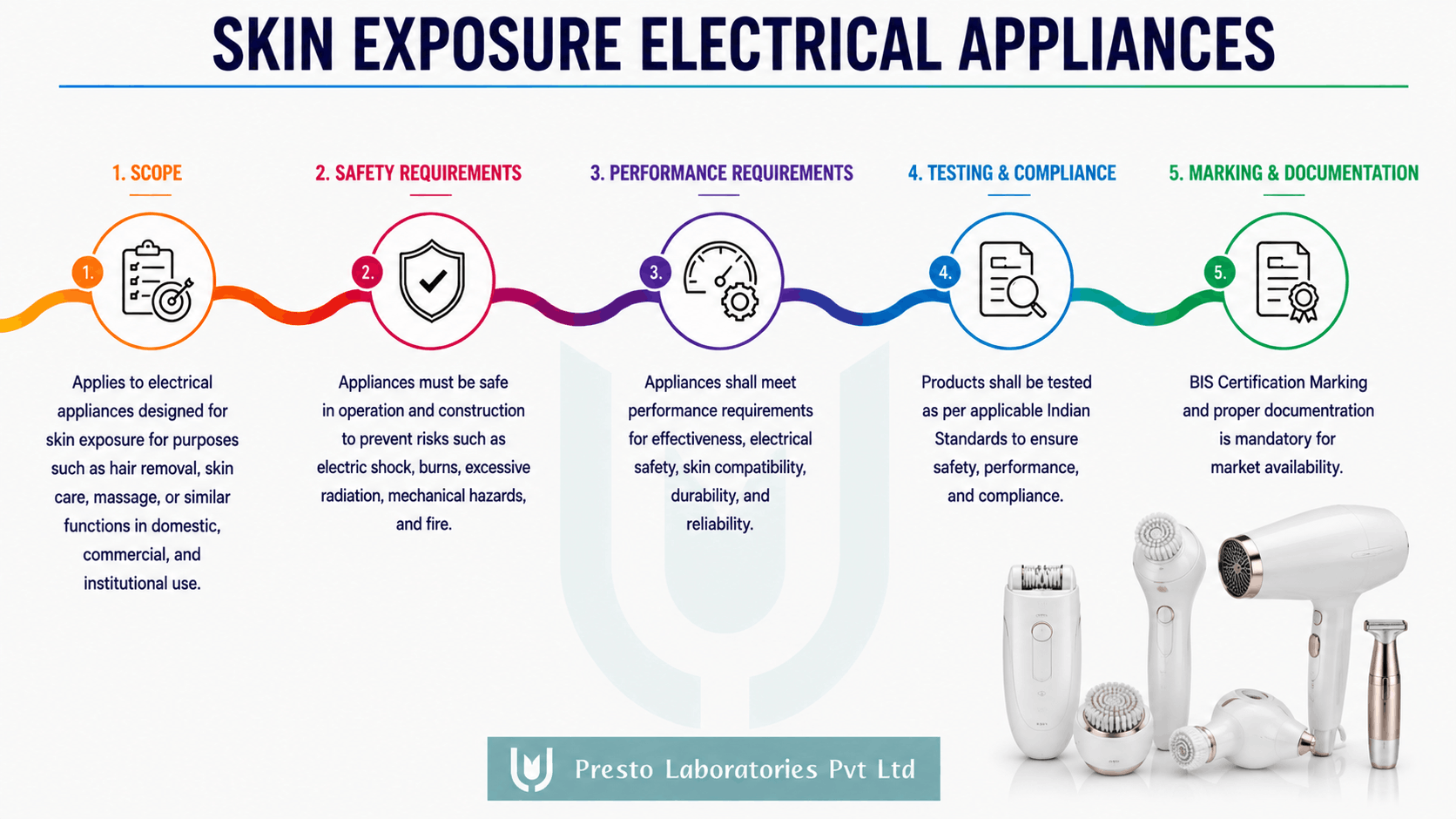
To get this mark, the maker has to hold an ISI mark for the product. Firms also have to follow licensing steps and QCO rules before sales can begin. Fees for BIS and customs play a part in the import and export journey. The right licence builds trust among buyers and helps brands move forward.
This standard covers safety for household appliances up to 250 V and for devices above 415 V used in shops and farm setups. The rules treat children as possible users, so extra care is included. Shock protection, earthing points, and moisture resistance form a core part of the checks. Extra tests help keep the user safe while the appliance is in use.
For more details on the process:
See the steps for Indian makers.
See the steps for foreign makers.
Indian makers: About thirty days
Foreign makers: Around one hundred eighty days
A BIS licence helps brands grow with safe products and steady acceptance in the market.
Presto Laboratories guides makers through the full process and supports them at each step.

 Talk to Us
 Book a Test
 Drop a Query