
Loading...
Highlighted industries are sectors that drive economic growth, innovation, and job creation. They often involve cutting-edge technologies, sustainable solutions.

We provide reliable testing solutions for solar and renewable energy companies. We make sure every component performs efficiently.

The helmet testing industry ensures safety and reliability for all forms of head protection in transportation, industry, defense, firefighting, and sports.

Fire extinguishers are vital fire-fighting gadgets that have been protecting different commercial, domestic, and food places since 1723.

We assure testing the domestic electrical equipment with the same rigor and care as industrial-grade machinery.

Low-speed food grinding machines are now seen in almost every kitchen. They make daily cooking easier, and many homes prefer them for steady and clean grinding. Such products come under IS 302 Part 2, Sec 209, and IS 302 Part 1. These standards specify how the machine is to be constructed and shall be tested so that it's safe and efficient to use in a home. As more families choose such machines, the demand for safe appliances continues to grow in India.
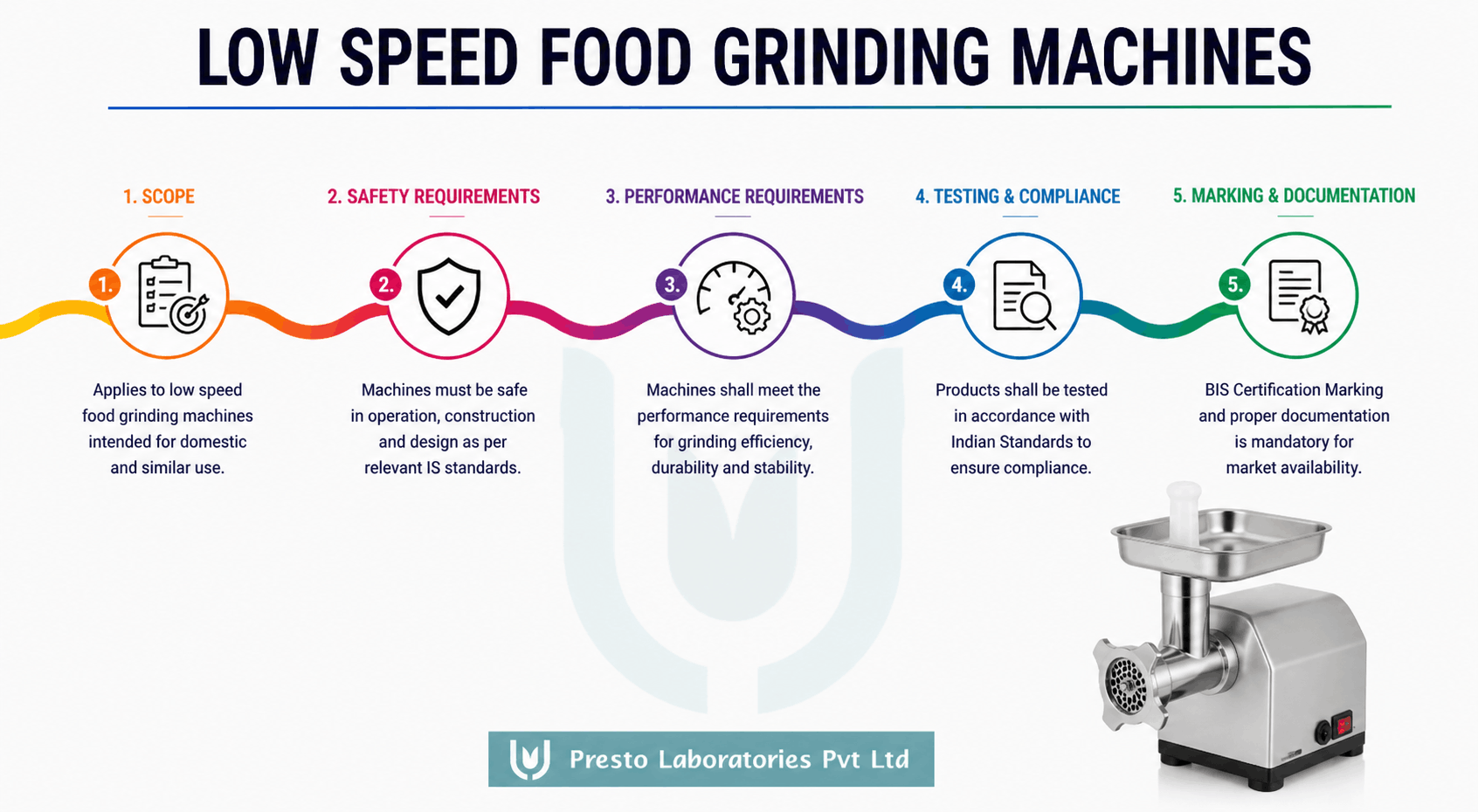
Any company that wants to sell these machines in the country must hold a valid ISI mark. This mark shows that the machine follows the set rules and passes the checks needed for sale. It also becomes useful when dealing with import or export work. Businesses planning to enter the Indian market often look at BIS fees, licensing steps, and customs clearance so they can move ahead without trouble.
IS 302 Part 2 Sec 209 1994 lists the safety needs for low-speed food grinding machines meant for household use. It covers electrical safety, material quality, build strength, and smooth running of the appliance. The rules also talk about design, marking, and general care. A product with the ISI mark shows that the maker has followed the required steps under BIS. Many companies choose online support for certification, along with the fee submission linked to the process.
BIS certification plays an active part in shaping trust around kitchen appliances in the country. It helps brands move ahead with cleaner processes and clearer direction. With the right guidance, makers and importers can bring their products to the Indian market without hurdles and offer machines that support safe everyday cooking.

 Talk to Us
 Book a Test
 Drop a Query