
Loading...
Highlighted industries are sectors that drive economic growth, innovation, and job creation. They often involve cutting-edge technologies, sustainable solutions.

We provide reliable testing solutions for solar and renewable energy companies. We make sure every component performs efficiently.

The helmet testing industry ensures safety and reliability for all forms of head protection in transportation, industry, defense, firefighting, and sports.

Fire extinguishers are vital fire-fighting gadgets that have been protecting different commercial, domestic, and food places since 1723.

We assure testing the domestic electrical equipment with the same rigor and care as industrial-grade machinery.

The IS 302 (Part 2 / Section 45):1994, along with IS 302 (Part 1), provides safety requirements of the electric heating tools used in households and small workplaces. These devices are very common in domestic, shopping, and expanding commercial areas in India. The need for such tools is increasing because of the rapid urbanization and the increased amount of construction. Import and export activities related to these products also remain strong.
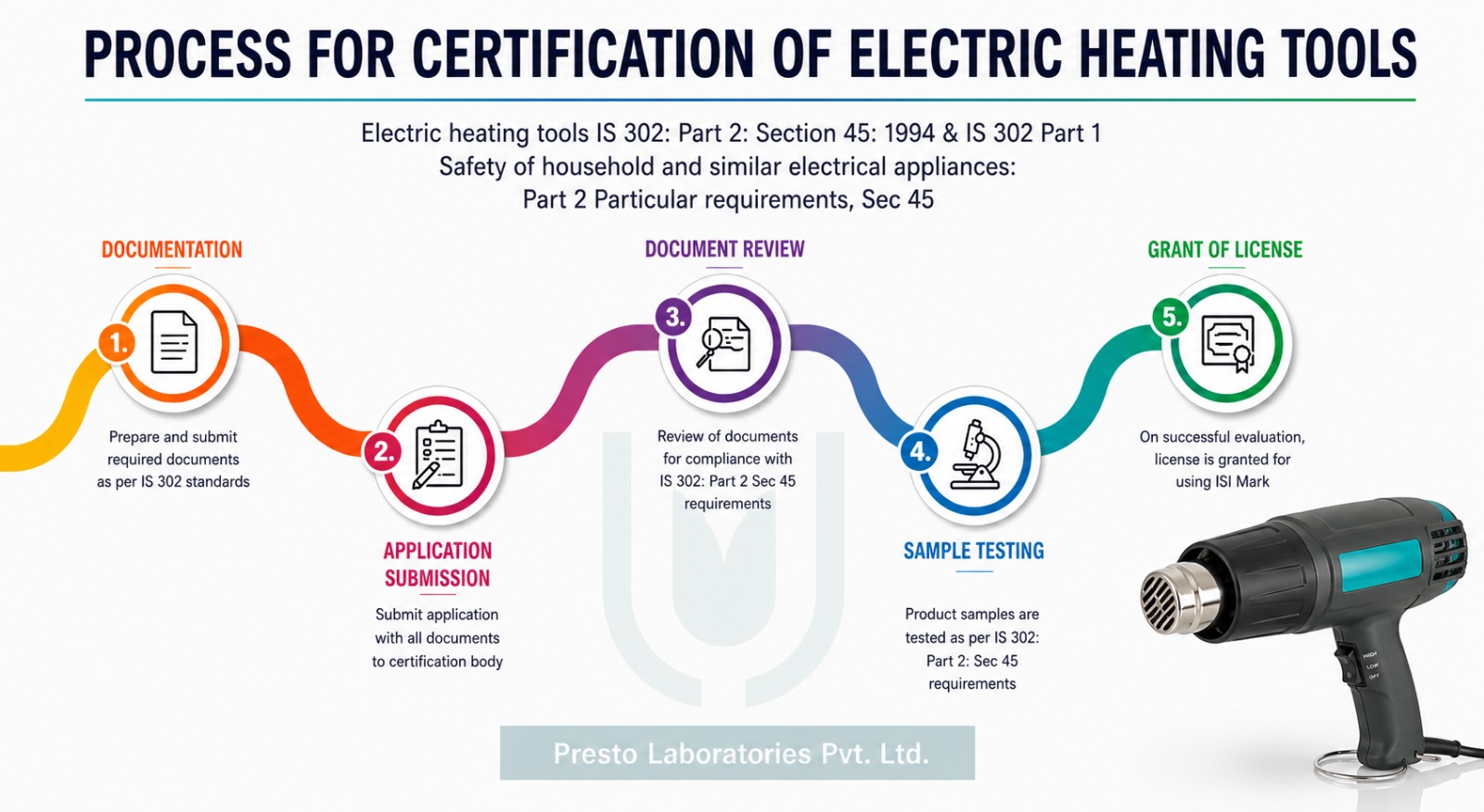
Any other manufacturer who is planning to sell the electric heating tools in India needs to gain BIS approval and apply the ISI mark. This certification helps with the unproblematic clearing of customs, as well as guarantees adherence to the relevant Quality Control Order (QCO). When a product bears the BIS mark, buyers will have more confidence in the safety and reliability of the product.
IS 302 (Part 2 / Section 45):1994 specifies safety requirements for electric heating tools intended for simple household and light work use. The standard addresses risks related to heat, electric shock, and safe handling. This section pertains to such products as soldering irons, glue guns, and heat guns.
The standard is not applicable to those tools that are employed in welding, high-frequency heating, brazing, and operations that are in hazardous environments or explosions. The tools, meant to be used by children, really old people, or in a special environment, might need more safety features.
BIS certification as per the requirement of IS 302 (Part 2 / Section 45): 1994 and IS 302 (Part 1) is essential in maintaining the safety of small workplace and home-type electric heating tools. The standards also assist manufacturers to come up with quality and compliant products that are acceptable in terms of Indian safety expectations.
Presto Laboratories assists the brands all through the certification process, including the firsthand guidance to the certification. By having well-defined procedures and having consistent support, manufacturers and importers can safely roll out safe and trusted electric heating tools within the Indian market.

 Talk to Us
 Book a Test
 Drop a Query