
Loading...
Highlighted industries are sectors that drive economic growth, innovation, and job creation. They often involve cutting-edge technologies, sustainable solutions.

We provide reliable testing solutions for solar and renewable energy companies. We make sure every component performs efficiently.

The helmet testing industry ensures safety and reliability for all forms of head protection in transportation, industry, defense, firefighting, and sports.

Fire extinguishers are vital fire-fighting gadgets that have been protecting different commercial, domestic, and food places since 1723.

We assure testing the domestic electrical equipment with the same rigor and care as industrial-grade machinery.

In today’s competitive market, brands cannot sustain growth without maintaining quality and offering certified products. There are a lot of electrical products that cannot be sold in India without a BIS license. In order to achieve this license, manufacturers should make sure that their products meet the relevant Indian Standard for that type
A summary of the IS 302 (Part 2 / Section 3), which is applicable to electric irons, is given below.
In this portion of the standard, the safety requirements of the electric iron, which is to be a combination of dry iron as well as steam iron that is supposed to be used at home or for any other similar purpose, are given. It also includes some irons that are fitted to a little external water tank, or boiler, of up to five liters' capacity. These are the kinds of appliances that can run on a voltage of up to 250 volts.
Some ironwork might not specifically be intended to be used in the home but is found in homes, stores, light industry workshops, or small agricultural operations. This standard also applies to such appliances, as they can also introduce similar safety risks.
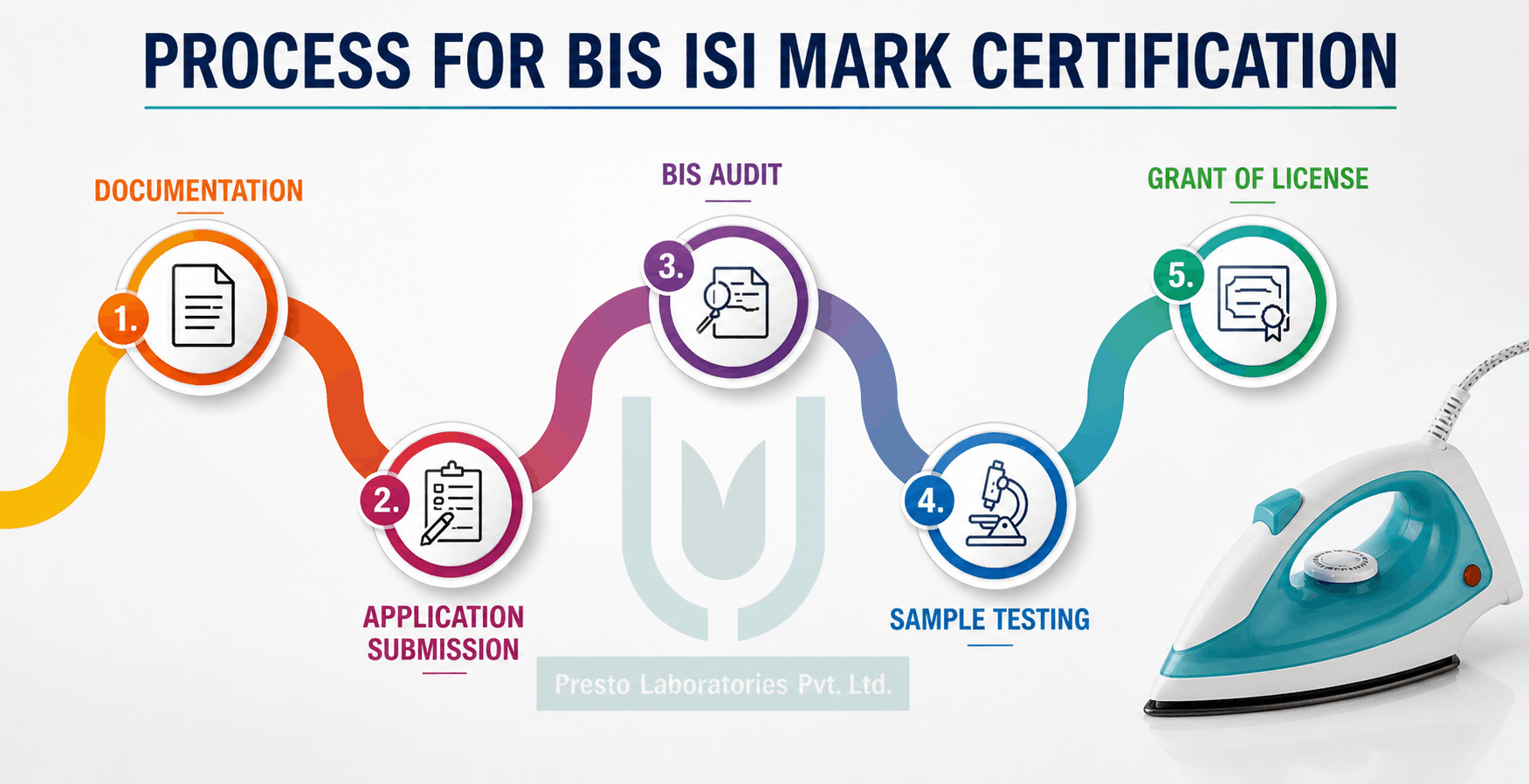
The label to be used on each electric iron should be one that is required by the standard. As soon as all safety and performance requirements are met and the product meets all those requirements, the manufacturer may use the ISI mark.
A BIS license is issued only after a thorough evaluation of the manufacturing facility, production process, quality control system, and in-house testing infrastructure.
Presto Laboratories assists brands at every stage of the BIS certification process, providing clear guidance and regulatory support to help manufacturers successfully place their electric irons in the Indian market.

 Talk to Us
 Book a Test
 Drop a Query