
Loading...
Highlighted industries are sectors that drive economic growth, innovation, and job creation. They often involve cutting-edge technologies, sustainable solutions.

We provide reliable testing solutions for solar and renewable energy companies. We make sure every component performs efficiently.

The helmet testing industry ensures safety and reliability for all forms of head protection in transportation, industry, defense, firefighting, and sports.

Fire extinguishers are vital fire-fighting gadgets that have been protecting different commercial, domestic, and food places since 1723.

We assure testing the domestic electrical equipment with the same rigor and care as industrial-grade machinery.


Tumbler dryers are widely used in textile and garment work. They help dry fabrics and clothes at a steady pace and support quick production. The demand has grown as more units look for clean drying and better energy use. Many brands also trade these dryers worldwide after meeting BIS rules and getting the ISI mark.
To get the ISI mark, a company must follow the BIS process and the QCO order. BIS clearance is needed for market entry in India. This approval lifts product value and builds trust in a busy market. Presto Laboratories supports manufacturers at every step.
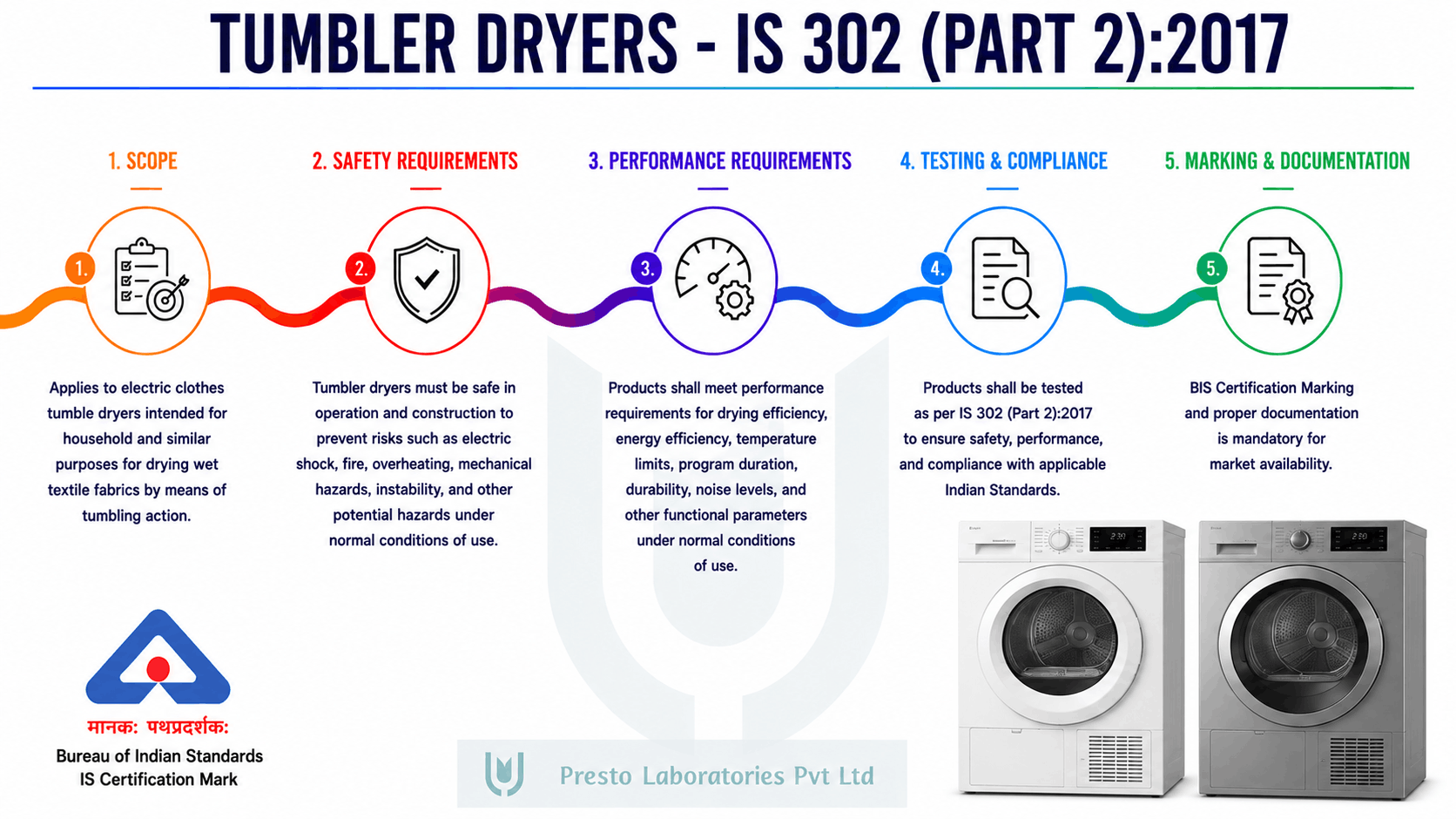
The standard explains the safety and working points for tumbler dryers. It covers electrical safety, heat control, and stable working for dryers up to 250 V. These dryers may be used at home, in shared laundry areas, or fitted inside washing machines. The rules do not cover heavy industrial dryers or dryers in risky places. Places with young children may need extra steps. Dryers for ships, vehicles, or aircraft may need added rules.
BIS certification keeps tumbler dryers safe and ready for use in the Indian market. Presto Laboratories guides manufacturers so they can meet all steps easily.

 Talk to Us
 Book a Test
 Drop a Query