
Loading...
Highlighted industries are sectors that drive economic growth, innovation, and job creation. They often involve cutting-edge technologies, sustainable solutions.

We provide reliable testing solutions for solar and renewable energy companies. We make sure every component performs efficiently.

The helmet testing industry ensures safety and reliability for all forms of head protection in transportation, industry, defense, firefighting, and sports.

Fire extinguishers are vital fire-fighting gadgets that have been protecting different commercial, domestic, and food places since 1723.

We assure testing the domestic electrical equipment with the same rigor and care as industrial-grade machinery.


This standard guides the safety rules for home and workplace appliances that use electric motors in furniture. It applies to items such as powered recliners, adjustable desks, and similar motor-based furniture used in homes, offices, and many commercial setups. These products are gaining attention in both local and overseas markets, as they bring comfort and movement features that many people now expect.
The BIS process for these items is not compulsory in India. It relates to ISI marking and QCO points. Makers and traders keep track of fees and steps that link to customs work, since it can shape import and export plans. Many firms choose online BIS channels to make the licensing path smoother.
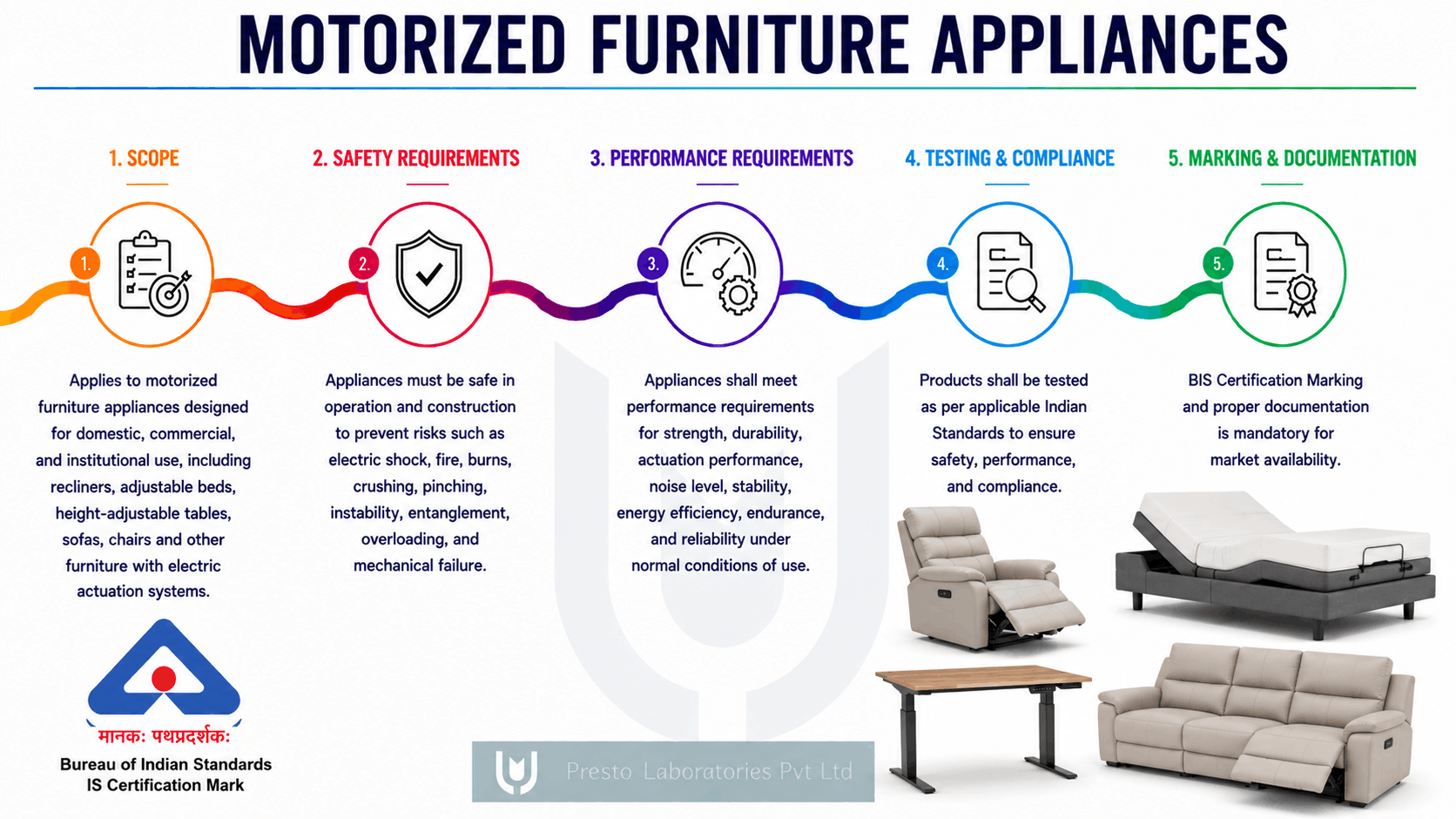
The standard sets out the safety rules for furniture that runs on single phase up to 250 volts. It also mentions light work areas and items that go up to 415 volts. The points mainly cover everyday risks that can appear around such appliances. It does not cover a scene where kids handle the product when no grown up is nearby. Large tools, medical devices, and other special machines are not included in this group.
BIS approval works as a strong step toward better quality and wider market reach. Presto Laboratories mentors makers and traders through every process in order to fit their products in the Indian market without difficulty.

 Talk to Us
 Book a Test
 Drop a Query