
Loading...
Highlighted industries are sectors that drive economic growth, innovation, and job creation. They often involve cutting-edge technologies, sustainable solutions.

We provide reliable testing solutions for solar and renewable energy companies. We make sure every component performs efficiently.

The helmet testing industry ensures safety and reliability for all forms of head protection in transportation, industry, defense, firefighting, and sports.

Fire extinguishers are vital fire-fighting gadgets that have been protecting different commercial, domestic, and food places since 1723.

We assure testing the domestic electrical equipment with the same rigor and care as industrial-grade machinery.


IS 302 Part 2 Section 32 1994 and IS 302 Part 1 set safety rules for massage appliances sold in India. Essentially, these focus on the safety of electric home or similar-use products. These include portable massagers, foot massagers, and shoulder massagers. They are used on a regular basis, and the market is growing. That is why Indian safety rules hold great value in this market.
BIS certification with the ISI mark is needed before these appliances can be traded. It helps with import and export and is linked with the QCO order. This mark shows that the product has passed the safety checks under BIS. Companies must plan the licensing steps and meet the needed points before applying.
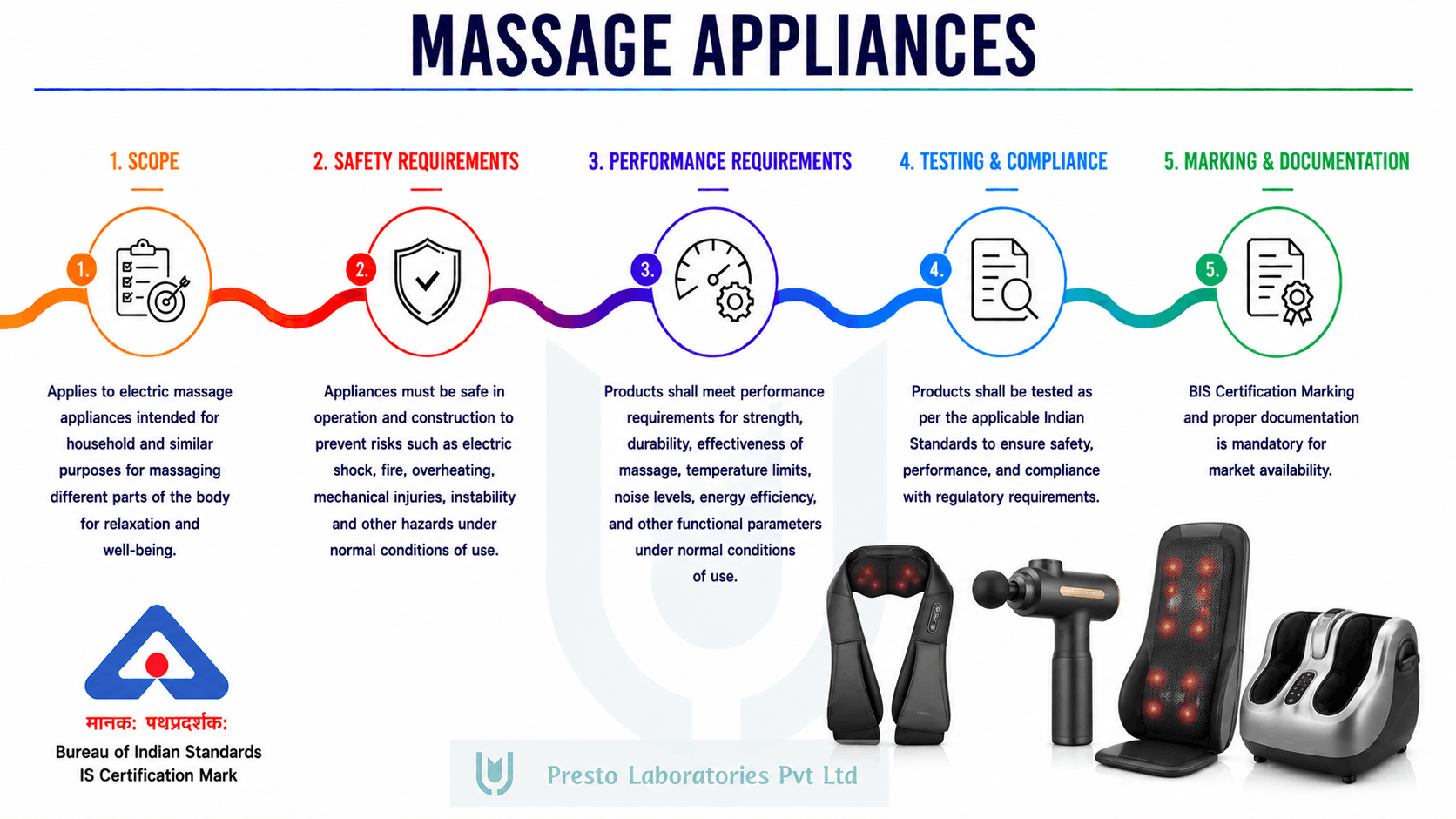
This standard lays out safety points for home massage appliances. It covers electrical and mechanical checks to avoid shocks, heat build-up, and other risks. It applies to products up to 250 V. It also covers some appliances used outside homes by non-professionals. It does not include special risks in places with young children or people who need extra care. Products in that setting may need more safety features. Makers must follow this standard before they can get BIS approval.
The usual time needed for massage appliances is as follows:
BIS work helps keep products safe and supports better growth in the Indian market. Presto Laboratories guides makers through this process with smooth handling and clear steps. Presto Laboratories helps both importers and makers meet the needed points for the Indian trade.

 Talk to Us
 Book a Test
 Drop a Query