
Loading...
Highlighted industries are sectors that drive economic growth, innovation, and job creation. They often involve cutting-edge technologies, sustainable solutions.

We provide reliable testing solutions for solar and renewable energy companies. We make sure every component performs efficiently.

The helmet testing industry ensures safety and reliability for all forms of head protection in transportation, industry, defense, firefighting, and sports.

Fire extinguishers are vital fire-fighting gadgets that have been protecting different commercial, domestic, and food places since 1723.

We assure testing the domestic electrical equipment with the same rigor and care as industrial-grade machinery.

IS 302 Part 1 2024 deals with the safety needs of household and commercial electric multipurpose cooking pans. This type of pan is a common appliance in kitchens, cafés, and restaurants. They are used for various cooking, frying, and baking applications, and so are commonly used for everyday cooking. The food industry is expanding rapidly, and social media is also driving more demand for these pans. This rise in demand creates space for imports and exports as well.
A BIS licence is now needed for these cooking pans. The ISI mark tells buyers that the product is safe to use. To get this mark, makers must follow BIS rules and complete the licence steps. They must also pay BIS licence fees and finish customs clearance when bringing goods into India.
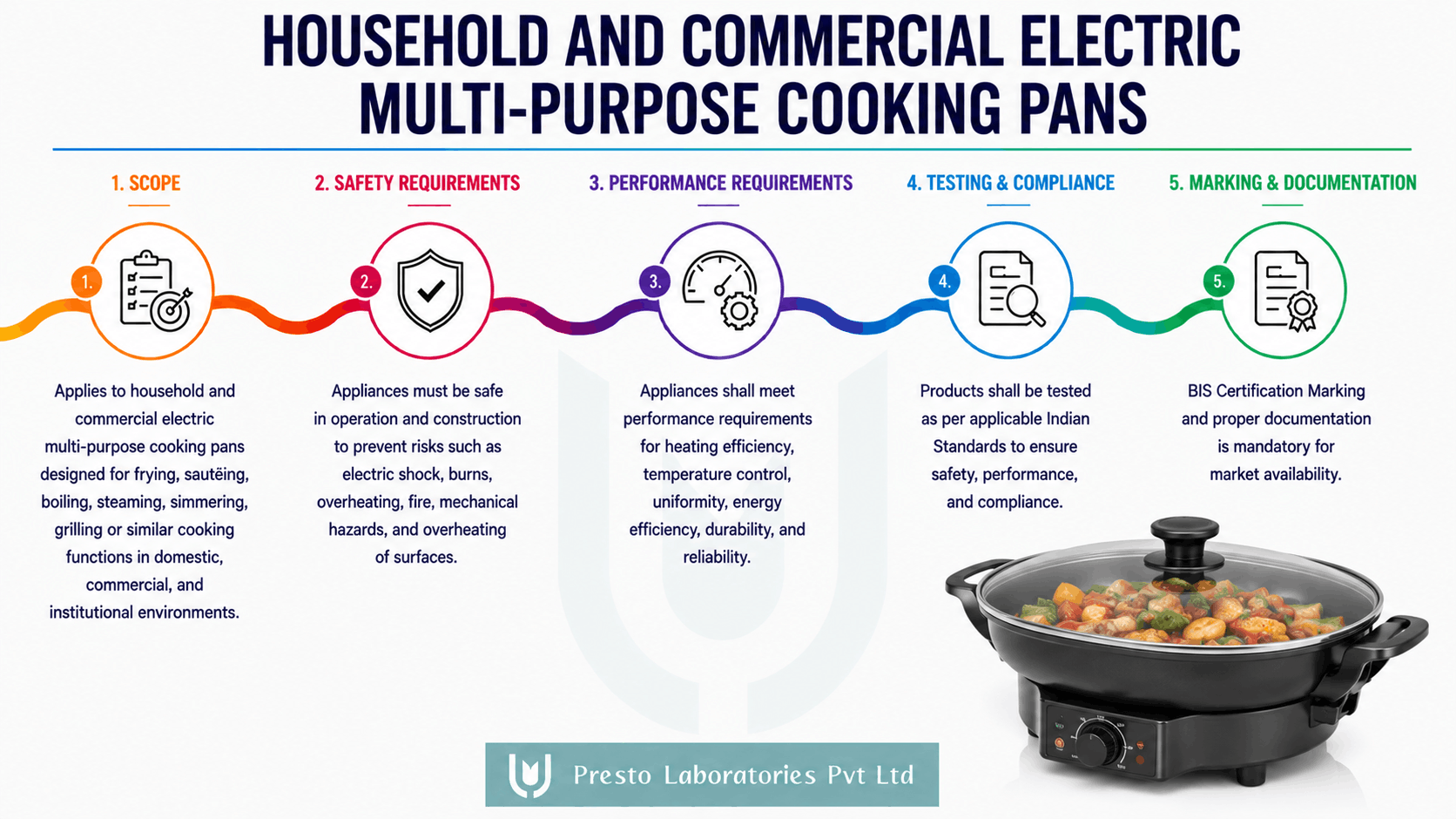
IS 302 Part 1 2024 lays down safety points for household electrical appliances like multi-purpose cooking pans. It covers appliances for single phase up to 250 V and other appliances for single phase higher than 415 V. The pans are called multipurpose cooking pans and are used in shops, houses, small kitchens, and on farms. The standard looks at common user risks and basic protective steps. Some industrial items and special electronic devices do not fall under this part of the standard.
A BIS licence brings trust and steady growth for makers of multi-purpose cooking pans in India. It helps brands gain space in a busy market and reach more buyers with safe kitchen tools. Presto Laboratories guides makers through testing, documents, and every step linked with BIS rules.

 Talk to Us
 Book a Test
 Drop a Query