
Loading...
Highlighted industries are sectors that drive economic growth, innovation, and job creation. They often involve cutting-edge technologies, sustainable solutions.

We provide reliable testing solutions for solar and renewable energy companies. We make sure every component performs efficiently.

The helmet testing industry ensures safety and reliability for all forms of head protection in transportation, industry, defense, firefighting, and sports.

Fire extinguishers are vital fire-fighting gadgets that have been protecting different commercial, domestic, and food places since 1723.

We assure testing the domestic electrical equipment with the same rigor and care as industrial-grade machinery.


This standard talks about the safety needs for electrolysers used in homes and commercial places. These appliances handle water treatment and hydrogen output, so their role carries weight in many common and industrial settings. The use of electrolysers is growing in India as clean energy and water systems expand. This growth helps in product demand and opens space for trade.
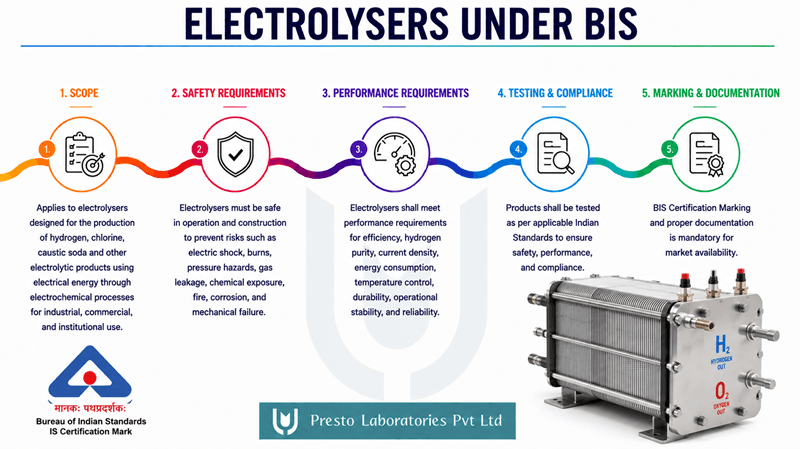
Any electrolyser sold in India must carry the ISI Mark and must follow the rules under the QCO order. Fees for BIS and customs shift from case to case, so staying aware of the BIS steps keeps trade smooth and free from trouble due to rule mistakes.
IS 302 Part 1 covers general safety needs for household and light commercial appliances, including electrolysers. It also covers products used in shops and small industrial setups where the risk level is higher. The rules cover basic safety only. They do not cover risks linked to very young users, elderly users, industrial machines, or medical tools.
This mark plays a strong part in building product confidence and market growth in India. Presto Laboratories guides makers and importers through the full BIS path.

 Talk to Us
 Book a Test
 Drop a Query