
Loading...
Highlighted industries are sectors that drive economic growth, innovation, and job creation. They often involve cutting-edge technologies, sustainable solutions.

We provide reliable testing solutions for solar and renewable energy companies. We make sure every component performs efficiently.

The helmet testing industry ensures safety and reliability for all forms of head protection in transportation, industry, defense, firefighting, and sports.

Fire extinguishers are vital fire-fighting gadgets that have been protecting different commercial, domestic, and food places since 1723.

We assure testing the domestic electrical equipment with the same rigor and care as industrial-grade machinery.


This standard lays down the safety points for electric washing machines made for home use. It directs makers to make clean machines that are safe for users. Such appliances have become household necessities, and the increasing demand in India has driven the need toward safe products that are effective. With this market increasing, the standard is of great worth to the brands that aspire to penetrate or expand in this market.
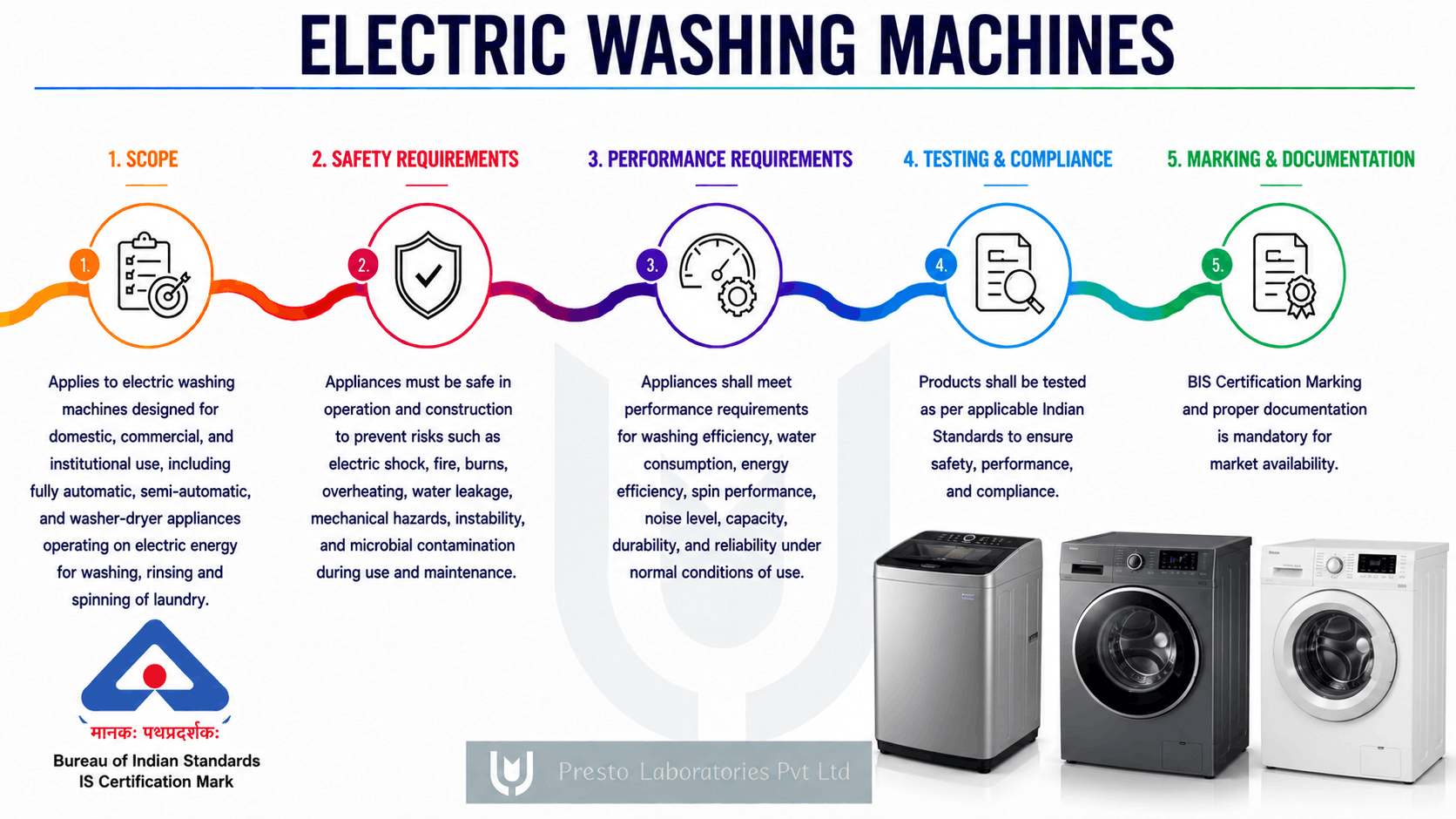
Washing machines sold in India need BIS approval. The ISI mark shows that the machine meets the needed safety points. BIS looks after product checks, rule following, and customs work linked to imports and exports. Makers and importers stay aware of these points so they can handle the steps linked to fees and clearance.
IS 302 Part 2 Section 7 sets the safety rules for home washing machines. It discusses electrical, heating, and traveling component safety. This is to prevent any risk, such as shocks, fire, and other dangers. The standard applies to machines used in houses and similar spots. It works for machines rated up to 250 volts for single-phase and up to 480 volts for others. It also includes points on design and markings.
BIS approval helps brands grow and build safer products for homes. Presto Laboratories takes manufacturers and dealers through the entire journey to ensure that they install their machines in the Indian market.

 Talk to Us
 Book a Test
 Drop a Query