
Loading...
Highlighted industries are sectors that drive economic growth, innovation, and job creation. They often involve cutting-edge technologies, sustainable solutions.

We provide reliable testing solutions for solar and renewable energy companies. We make sure every component performs efficiently.

The helmet testing industry ensures safety and reliability for all forms of head protection in transportation, industry, defense, firefighting, and sports.

Fire extinguishers are vital fire-fighting gadgets that have been protecting different commercial, domestic, and food places since 1723.

We assure testing the domestic electrical equipment with the same rigor and care as industrial-grade machinery.

Running a product in today’s market is tough without steady quality and the right mark. A BIS mark may be needed for selling in India. Makers have to follow the points set in the Indian Standard before they move ahead.
IS 302 2 201 2008 talks about electric immersion water heaters. It was taken up after the draft was cleared by the Electrotechnical Division Council.
The paper addresses safety requirements of portable immersion heaters in residential and low-intensity workplaces. These heaters do not operate beyond 250 V. Not all appliances are suitable to be used by people at home, but they can still find their way to the small shops, light industry, or farms; thus, the safety considerations apply there as well.
An immersion heater is made by placing a heating wire inside a ceramic tube. This tube sits inside a metal cover. The cover can be copper, steel, cast iron, titanium, or a PFA-coated type.
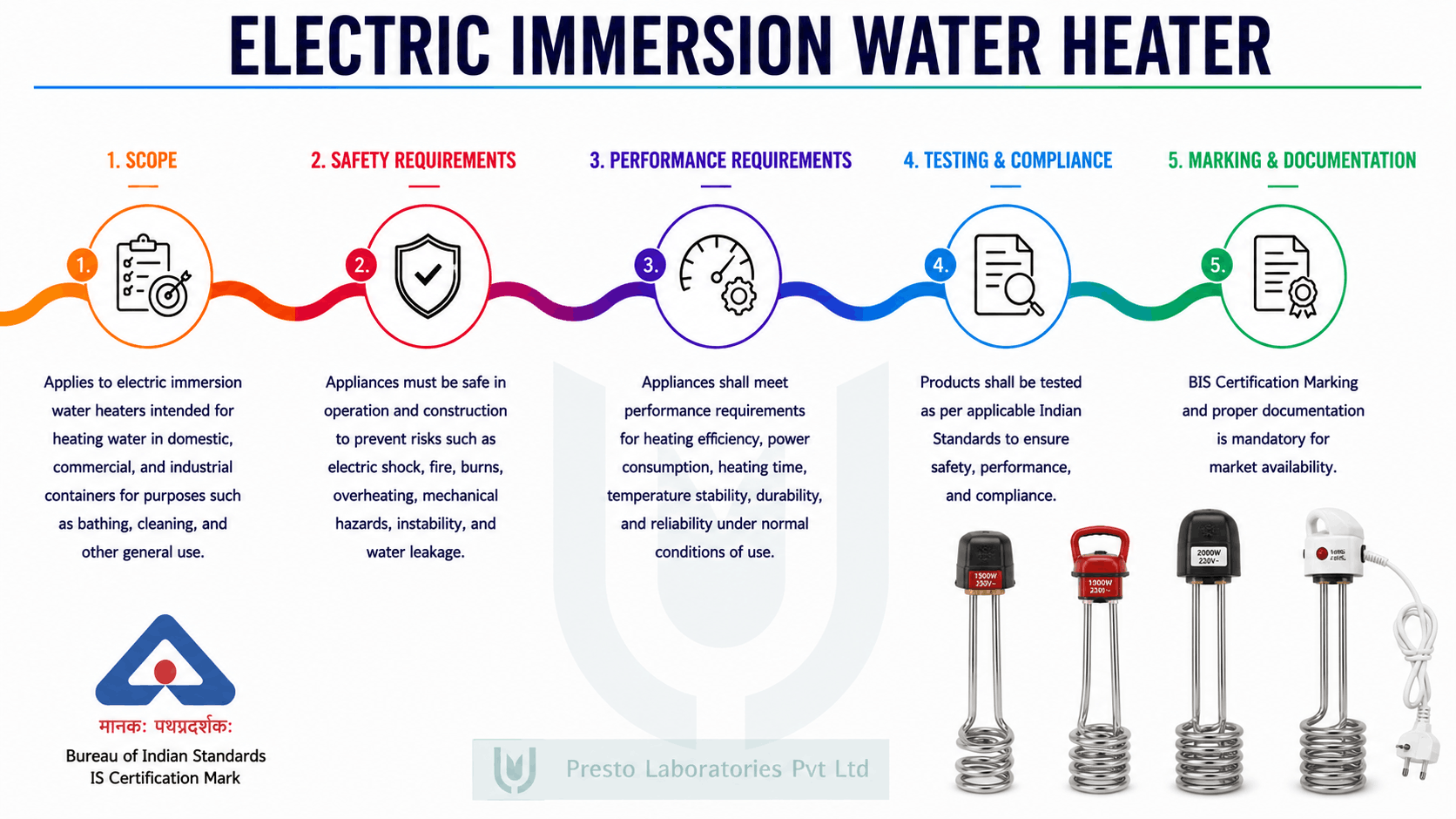
These checks are carried out in a proper lab that follows the methods in the standard.
The producer must provide the samples of what they would like to license. In IS 302 2 201 2008, the points are followed by the marks and labels. The product must satisfy the previously mentioned points, and the ISI mark can be added upon granting of the license.
A BIS licence for immersion heaters is given only after the factory setup, process flow, and testing setup are checked in person.
For more details, you can read about the steps for Indian makers and foreign makers on the BIS portal.
Any product that falls under this scheme has to carry a BIS ISI mark. If a product does not meet the needed points, the licence may be withdrawn. Presto Laboratories helps makers and traders meet the rules for selling their items in the Indian market.

 Talk to Us
 Book a Test
 Drop a Query