
Loading...
Highlighted industries are sectors that drive economic growth, innovation, and job creation. They often involve cutting-edge technologies, sustainable solutions.

We provide reliable testing solutions for solar and renewable energy companies. We make sure every component performs efficiently.

The helmet testing industry ensures safety and reliability for all forms of head protection in transportation, industry, defense, firefighting, and sports.

Fire extinguishers are vital fire-fighting gadgets that have been protecting different commercial, domestic, and food places since 1723.

We assure testing the domestic electrical equipment with the same rigor and care as industrial-grade machinery.


IS 302 Part 2 Section 203:1994, together with IS 302 Part 1, defines the safety requirements for indoor electric call bells and buzzers in India. These devices are commonly used in homes, offices, hospitals, shops, and modern smart living spaces. With increasing use of connected and automated systems, the demand for reliable call bells and buzzers has grown in both domestic and global markets. Since these devices are used daily, safe design and consistent performance are essential.
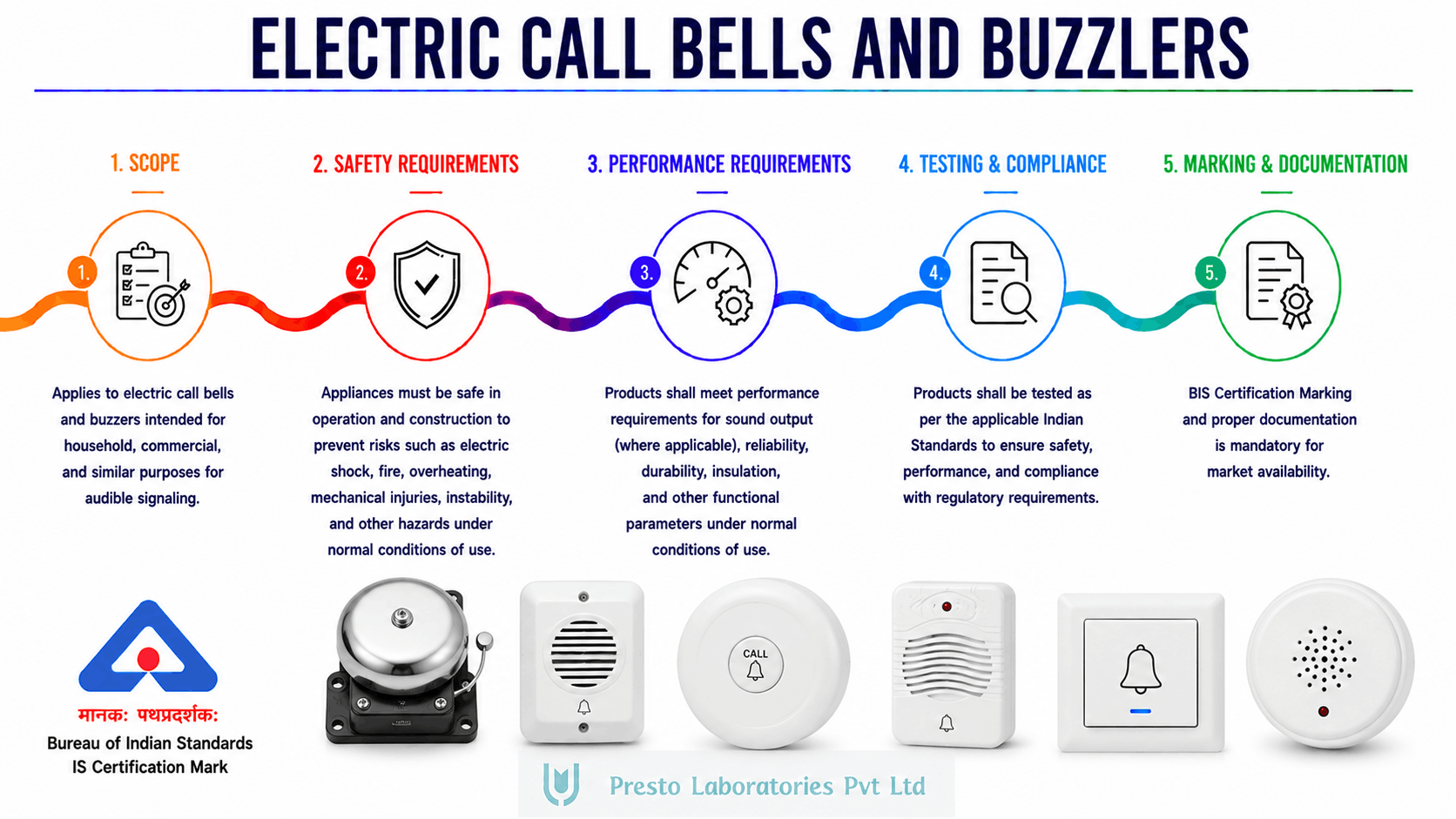
To sell these products in India, BIS approval is mandatory. The ISI mark indicates that the product complies with the required safety rules. Manufacturers can apply online for the BIS licence. Being aware of fee structures and customs procedures ensures smooth import or domestic distribution. BIS certification builds buyer trust and helps brands enter the Indian market confidently.
IS 302 Part 2 Section 203:1994 outlines safety and operational requirements for call bells and buzzers that operate at a supply up to 250 V AC or DC. The standard also updates and replaces certain points from older rules. Call bells produce a ringing sound, while buzzers generate sound via an armature mechanism. These rules ensure user safety during daily operation.
BIS certification guarantees safety when using indoor electric call bells and buzzers in domestic households and enables manufacturers to build consumer trust in India. Presto Laboratories helps manufacturers with testing, documentation, and license applications to product acceptance in the market.

 Talk to Us
 Book a Test
 Drop a Query