
Loading...
Highlighted industries are sectors that drive economic growth, innovation, and job creation. They often involve cutting-edge technologies, sustainable solutions.

We provide reliable testing solutions for solar and renewable energy companies. We make sure every component performs efficiently.

The helmet testing industry ensures safety and reliability for all forms of head protection in transportation, industry, defense, firefighting, and sports.

Fire extinguishers are vital fire-fighting gadgets that have been protecting different commercial, domestic, and food places since 1723.

We assure testing the domestic electrical equipment with the same rigor and care as industrial-grade machinery.

IS-302 Part 1: 2024 deals with electric bain-maries. These units are used in hotels, restaurants, and catering for maintaining food warmth. The units are in high demand due to the requirement for restaurants and hotels to have reliable performance and stable temperature control. Most brands also consider exports and imports, as customers look for safety-compliant products.
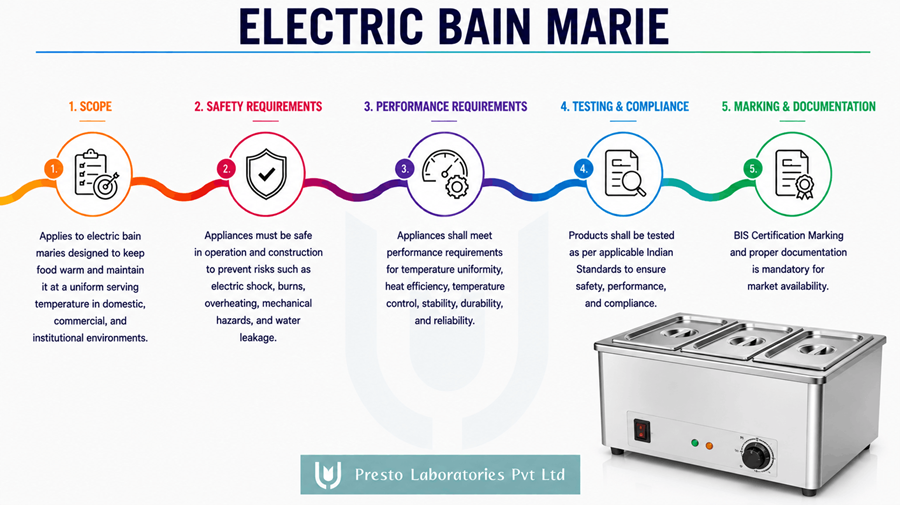
Anyone planning to sell these appliances in India must hold a BIS license with the ISI mark as mentioned in the QCO. The fee, the application steps, and the customs process form a major part of compliance. The online portal helps brands apply without long delays, which makes the process smoother for new suppliers.
IS 302 Part 1: 2024 applies to household appliances and commercial bains marie working on single-phase supply up to 250 V and other types up to 415 V. It focuses on day-to-day risks linked with electrical machines used in kitchens, shops, and farm areas. A few items, like heavy industrial tools, are not counted under this rule.
BIS approval plays a strong part in shaping product quality for kitchen appliances in India. Many food service businesses look for a certified Bains-Marie for safety and long-term use. Presto Laboratories supports every part of the approval process and equips manufacturers to confidently advance in the Indian market. This ensures safe, efficient, and consistent appliances in the market.

 Talk to Us
 Book a Test
 Drop a Query