
Loading...
Highlighted industries are sectors that drive economic growth, innovation, and job creation. They often involve cutting-edge technologies, sustainable solutions.

We provide reliable testing solutions for solar and renewable energy companies. We make sure every component performs efficiently.

The helmet testing industry ensures safety and reliability for all forms of head protection in transportation, industry, defense, firefighting, and sports.

Fire extinguishers are vital fire-fighting gadgets that have been protecting different commercial, domestic, and food places since 1723.

We assure testing the domestic electrical equipment with the same rigor and care as industrial-grade machinery.


Cooking units like ranges, hobs, and ovens need a BIS stamp before they reach stores in India. These machines heat food in many homes and small kitchens. People want units that save power and do more work in less time. This makes safety checks important.
The rules for these units sit under IS 302 Part 2, Sec 6, and the main section of IS 302 Part 1. These rules guide the safety side of home cooking units. Makers must follow the test path before placing these units on the market.
Presto Laboratories helps makers with papers, samples, and the full path for the BIS stamp. Once the unit clears the steps, the maker gets the stamp for that model.
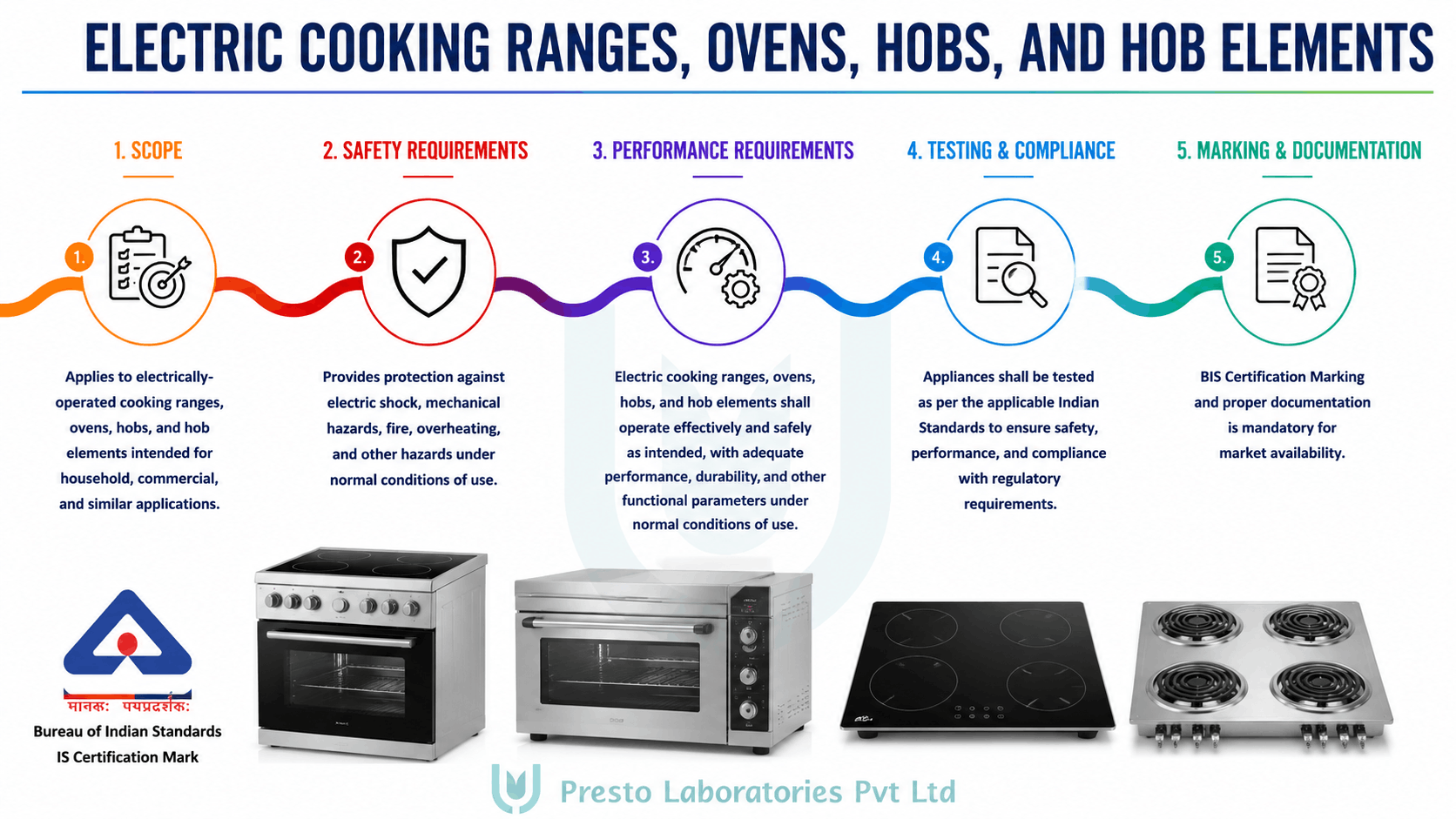
IS 302 Part 2 Sec 6 talks about safety points for cooking units that work on power up to 250 volts in single-phase and 480 volts in other cases. It deals with heat points, shock risk, building strength, and day-to-day use. It leaves out heavy-duty commercial units, portable cooking tools, and microwave units.
BIS clearance lifts the safety value of cooking units. Presto Laboratories helps makers move through the steps with ease.

 Talk to Us
 Book a Test
 Drop a Query