

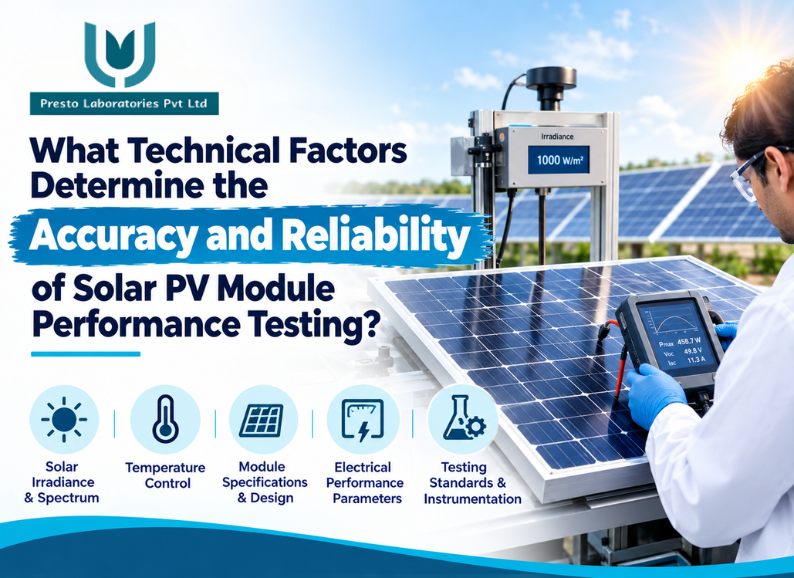
It is crucial that the performance of the photovoltaic (PV) module remains consistent for successful and efficient production of solar energy. Yet, it takes accurate measurements, which in turn require the proper environment for testing and correct methods for testing as well. Selection of a Solar PV Module Testing Laboratory in Delhi NCR provides relevant data on module performance.
Presto Laboratories is one such name that businesses may consider in regard to their needs for laboratory testing services as well as their understanding of factors affecting the accuracy of test results. The performance testing of solar PV modules consists of more than just determining the amount of electricity produced. During this testing procedure, some critical electrical parameters are analyzed, performance variations are checked, and finally, the module is verified to determine whether it fulfills the requirements concerning its usage. Measurement errors caused by temperature, irradiance, and calibration of the instruments may influence the test results.
Energy is obtained from solar PV panels due to the action of the sun. The level of energy will vary with the environment at hand and the parameters of the electricity. Variables like the sun's strength, the temperature of the module, and even the measuring equipment employed can influence the measurement. Improper handling of the variables and measurement process would be likely to lead to inaccurate results. Proper measurements are essential when comparing devices by different producers or verifying the ratings of a particular panel.
For manufacturers, repeatable tests contribute to ensuring quality control and developing their products. Procurement departments of solar projects can make use of the test reports in order to analyze the performance characteristics of modules before purchasing them. Repeatable tests also allow revealing anomalies in performance that need further study. Hence, choosing a lab that has proper equipment, procedures, and necessary qualifications is an integral stage of the process.
Solar irradiance refers to the solar power received per unit area. It directly influences the electrical output of a PV module and is one of the most important variables in performance testing. Standard test conditions generally specify an irradiance level of 1,000 W/m². During laboratory testing, the light source must provide suitable intensity and remain stable throughout the measurement process. Changes in irradiance can affect the measured current and power output, making results difficult to compare.
Solar simulators can be used by laboratories to simulate desired lighting conditions. The spectral nature, uniformity, and stability over time of the solar simulator will affect the measurement process. It is imperative that the process be monitored to ensure that there is consistency with respect to the light on the solar cell during the testing process. In assessing solar PV module testing labs, it is important for business owners to determine if the lab has proper irradiance measurement procedures in place.
The effect of temperature on the electrical performance of solar PV modules is directly proportional. In the standard test condition, the reference cell temperature is 25°C. Nevertheless, the real temperature of the module will depend on the situation and conditions in which it operates. For normal PV modules with crystalline silicon technology, increasing temperatures cause a reduction in voltage and peak power. This effect depends on the temperature coefficients for each technology of the module.
The tests must be conducted using the appropriate temperature sensors, the proper placement of these sensors, and enough time for the module to achieve the required temperatures. The temperature test must indicate the module’s condition and not just the air temperature around the module. Inadequate temperature control could result in inconsistent readings that make product comparisons difficult. Proper procedures will enable laboratories to derive more meaningful results from the measurements.
The reliability of solar PV modules' testing will greatly depend on the measuring instruments used for the tests. The instruments might include reference cells, irradiance sensors, temperature sensors, voltage meters, instruments for current measurement, and an electronic load. In case the instruments measure incorrectly or they are not calibrated properly, then the results obtained from the tests will be inaccurate even though the process of testing was done properly. Calibration will help to understand the correlation between instrument readings and the recognized measurement standards. The laboratories should have good calibration schedules and records. The instruments should also have adequate measurement ranges, resolution, and uncertainties in relation to the tests done.
The capacity of a laboratory for performing tests, therefore, must not only consider the presence of advanced equipment. Calibrating techniques, traceability of measurement, as well as instrument maintenance are also crucial in evaluating whether it can aid in technical and quality-related decision-making.
The I-V graph is one of the most essential methods to analyze the performance of an electrically based solar PV module. The I-V graph shows the relationship of current against voltage in different electrical loads on a PV cell. Some significant parameters that are found in the I-V graph include:
Open-circuit voltage (Voc): Voltage when there is no flow of current.
Short-circuit current (Isc): Current when there is a short circuit between the terminals of the module.
Maximum power (Pmax): Maximum power generated by the module on the I-V curve.
Maximum power point voltage and current (Vmp and Imp): Voltage and current corresponding to the maximum power generation by the module.
Fill Factor: Parameter that gives the relationship between maximum power and the product of open-circuit voltage and short-circuit current.
Accurate measurement of these parameters will call for the correct types of electronic loads, proper electrical connections, proper data acquisition methods, and proper tests being done. Electrical noise, loose connections, and improper measurement will alter the measured values. The test equipment will measure the graph while using the right parameters and processing it accordingly. Proper measurement techniques make comparison between the modules easier to conduct.
Solar simulators have to duplicate the qualities of the sunlight in such a way that they will be adequate for the test method chosen. Two key factors here are spectral match and spatial uniformity. Spectral match is concerned with the way in which the spectrum of light provided by the simulator matches the spectrum of sunlight. This may affect the results because different kinds of cells are more sensitive to certain wavelength ranges, thus producing different output results. Spatial uniformity is related to the uniformity of light across the surface of the module.
Classification of the simulator, proper evaluation of its performance, and following the correct test procedure will assist in determining if the lighting conditions are appropriate. This is especially true in cases where there is a need for consistent measurements to be taken in various modules.
The physical condition of the photovoltaic modules is another factor that might affect the tests performed. Contamination by dust, presence of visible defects, poor electrical contacts, or mishandling are factors that may lead to measurement challenges. Prior to any testing process being conducted, it is important to identify and examine the module according to the particular test protocol.
When more than one module is going to be tested, consistency will become extremely important. Different preparation techniques might cause variance that does not reflect the quality of the products. Proper handling and recording will help prevent any unnecessary mistakes. Furthermore, this practice will help detect any unusual readings and will make repeating tests easier.
Adequate test results are achieved by using the right test standards, proper procedure, and interpretation of data. Inaccurate results will still be achieved even if adequate equipment is used if the test procedure used is not appropriate and the data is interpreted wrongly. Test standards like IEC 60904 deal with measurement of PV device parameters, whereas IEC 61215 deals with design qualification and type approval tests for terrestrial PV modules. The right standard and version should be used depending on the particular module, test purpose,e and requirements. Data interpretation is just as important. Laboratories should scrutinize any odd data, make any necessary corrections, ns and interpret data in consideration of measurement uncertainties.
It is important that a good report on a test result shows what module was tested, what the test procedure was, what the conditions were, and what the parameters obtained were. It is also useful to mention any limitations in connection with the test.
The choice of a testing laboratory demands the careful consideration of the laboratory's technical capabilities and product specifications. Business owners should learn more about the way the laboratory performs tests and what data it reports. The following aspects need to be considered when choosing a testing laboratory: its testing range, suitability of equipment used, equipment calibration process, and environmental variable controls. There is also an issue of learning which editions of particular standards are used for the needed evaluation. One more thing that needs to be taken into account is the laboratory's accreditation. This matter concerns businesses interested in getting some sort of independent recognition. It is necessary to make sure that the specific test is covered by laboratory accreditation.
Report practices are also very important. The test reports must be clear in presenting the results, describe the conditions in which the testing was carried out, and give enough details for the technical review. Asking these questions before choosing a laboratory will help businesses to find the right service.
There are various interrelated technical factors that influence the accuracy and reliability of solar PV module performance testing, such as stability of irradiance, temperature, calibration of equipment used for testing, quality of electrical measurements, characteristics of simulators, proper handling of modules, and compliance with corresponding standards. The control of these factors ensures consistency of results and contributes to making appropriate decisions regarding the quality of the module and its electrical performance. The selection of a suitable Solar PV Module Testing Lab in Delhi NCR is an important step for manufacturers and solar project developers.
Presto Laboratories may also come to mind when one looks at testing requirements, with the ultimate decision depending upon the scope of the tests, equipment, and standard and accreditation information. Knowing about these technical requirements will assist companies in testing their solar PV modules and setting the stage for quality assurance.
It is the process of testing the electrical output and operational parameters of the module under certain conditions. This procedure allows calculating parameters like maximum power, voltage, and current to check whether the module satisfies performance criteria.
The performance characteristics of solar PV modules depend on temperature, especially when it comes to voltage and power output. Proper temperature measurement ensures that results are measured under the right test conditions and compared effectively.
I–V curve describes the relationship between current and voltage of the solar PV module under certain conditions. With its help, you can calculate parameters like open-circuit voltage, short-circuit current, and maximum power.
Instrument calibration helps to ensure that the measuring devices give reliable readings. Well-calibrated instruments help to decrease measurement errors and increase the confidence level of the reported performance results.
There are several aspects that the company needs to consider while selecting the laboratory, such as testing capabilities, calibration of the instruments, testing standards, measurement process, reporting, and accreditation.


 Talk to Us
 Book a Test
 Drop a Query